

The effects of activated carbon from palm shell for air filter

Authors

  • Abdul Mutalib Leman Faculty of Engineering Technology, Universiti Tun Hussein Onn Malaysia Universiti Tun Hussein Onn Malaysia, Pagoh Campus, 84600 Pagoh, Johor, Malaysia
  • Farwizah Yusrin 1Faculty of Engineering Technology, Universiti Tun Hussein Onn Malaysia, Pagoh Higher Education Hub, Pagoh Campus, 84600 Pagoh, Johor, Malaysia
  • Noraini Marsi Faculty of Engineering Technology, Universiti Tun Hussein Onn Malaysia, Pagoh Higher Education Hub, Pagoh Campus, 84600 Pagoh, Johor, Malaysia
  • Mohd Syafiq Syazwan Mustafa Faculty of Engineering Technology, Universiti Tun Hussein Onn Malaysia, Pagoh Higher Education Hub, Pagoh Campus, 84600 Pagoh, Johor, Malaysia
  • Abdul Murad Zainal Abidin JKR Centre of Excellent for Engineering and Technology (CREaTE), 78000 Alor Gajah, Melaka, Malaysia
  • Anuar Pawan Mohamad Fikri Mohamad Yunus JKR Centre of Excellent for Engineering and Technology (CREaTE), 78000 Alor Gajah, Melaka, Malaysia
  • Tengku Muhammad Ibrahim Salahuddin Tengku JKR Centre of Excellent for Engineering and Technology (CREaTE), 78000 Alor Gajah, Melaka, Malaysia

Keywords:

Activated carbon, Palm Shell, Air filter, Carbonization, Thermal stability

Abstract

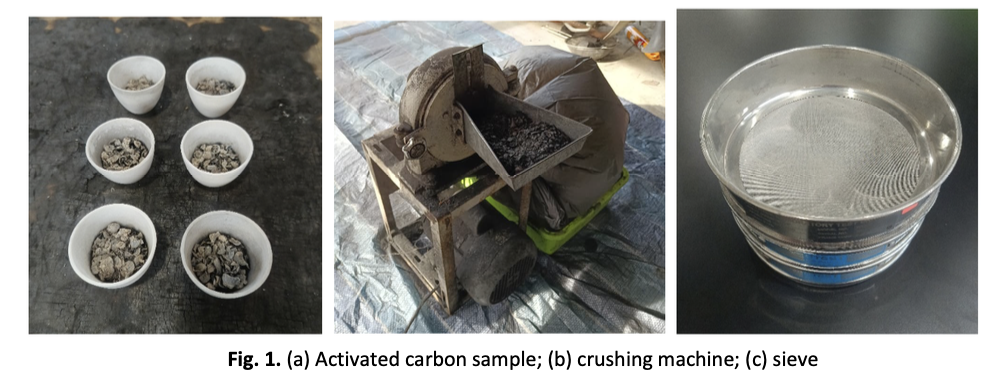
Air pollution around the globe and the steadily deteriorating condition of indoor air quality (IAQ) are serious environmental and health issues in today’s world, as people tend to spend up to 90% of their lives indoors as part of their modern living habits. There is serious health concerns associated with poor IAQ, which include respiratory and chronic ailments. The use of activated carbon as filtering material in air cleaners has been greatly encouraged because of its higher adsorption capacity, though most of today’s commercial activated carbons are made from expensive sources of coal and oil. Therefore, there is a great need for affordable and sustainable materials. Palm shells, which are produced abundantly as agricultural waste in the palm oil industry in Malaysia, are promising materials for activated carbon synthesis. The focus of this research is to examine the ability of the produced activated carbon, which is derived using palm shells, based on its structural and chemical properties, in air filtration applications. Palm shells were carbonized using a pyrolysis technique with activation using Sodium Hydroxide as the chemical agent. The produced activated carbon was then characterized using the Scanning Electron Microscopy for the shape and structure, the FTIR for the functional groups, and the TGA for the thermal stability and decomposing process. The findings indicate that the carbonization temperature plays a significant role in determining the characteristics of the palm shell activated carbon. Analysis conducted using the SEM revealed that the activated carbon created from the 600°C activation procedure possessed a strong internal porous structure, while the activated carbon created from the 550°C procedure lacked pores and that from the 650°C procedure displayed enlarged pores. FTIR analysis confirmed the presence of –O–H, C=C, and C–O functional groups, with the 600°C sample showing the most favorable surface functionality for adsorption. Furthermore, the TGA analysis illustrated that the activated carbon created from the higher-temperature procedures possessed better thermal stability.

Author Biographies

Abdul Mutalib Leman, Faculty of Engineering Technology, Universiti Tun Hussein Onn Malaysia Universiti Tun Hussein Onn Malaysia, Pagoh Campus, 84600 Pagoh, Johor, Malaysia

mutalib@uthm.edu.my

Farwizah Yusrin, 1Faculty of Engineering Technology, Universiti Tun Hussein Onn Malaysia, Pagoh Higher Education Hub, Pagoh Campus, 84600 Pagoh, Johor, Malaysia

an210107@student.uthm.edu.my

Noraini Marsi, Faculty of Engineering Technology, Universiti Tun Hussein Onn Malaysia, Pagoh Higher Education Hub, Pagoh Campus, 84600 Pagoh, Johor, Malaysia

mnoraini@uthm.edu.my

Mohd Syafiq Syazwan Mustafa, Faculty of Engineering Technology, Universiti Tun Hussein Onn Malaysia, Pagoh Higher Education Hub, Pagoh Campus, 84600 Pagoh, Johor, Malaysia

mohdsyafiq@uthm.edu.my

Abdul Murad Zainal Abidin, JKR Centre of Excellent for Engineering and Technology (CREaTE), 78000 Alor Gajah, Melaka, Malaysia

abdmurad@jkr.gov.my

Anuar Pawan Mohamad Fikri Mohamad Yunus, JKR Centre of Excellent for Engineering and Technology (CREaTE), 78000 Alor Gajah, Melaka, Malaysia

anuarp@jkr.gov.my

Tengku Muhammad Ibrahim Salahuddin Tengku, JKR Centre of Excellent for Engineering and Technology (CREaTE), 78000 Alor Gajah, Melaka, Malaysia

tengkuibrahim@jkr.gov.my

Downloads

Published

2026-10-22

Issue

Section

Articles