

Effect of Sand Layer Thickness on Heat Distribution and Effective Thermal Properties for an IoT-Monitored Artificial Heated Habitat

Authors

  • Khaw Zhi Xian School of Mechanical Engineering, Tuanku Syed Sirajuddin Engineering Campus, Universiti Sains Malaysia, 14300 Nibong Tebal, Pulau Pinang, Malaysia
  • Mohd Syakirin Rusdi School of Mechanical Engineering, Tuanku Syed Sirajuddin Engineering Campus, Universiti Sains Malaysia, 14300 Nibong Tebal, Pulau Pinang, Malaysia
  • Muhammad Hafiz Hassan School of Mechanical Engineering, Tuanku Syed Sirajuddin Engineering Campus, Universiti Sains Malaysia, 14300 Nibong Tebal, Pulau Pinang, Malaysia
  • Muhammad Fauzinizam Razali School of Mechanical Engineering, Tuanku Syed Sirajuddin Engineering Campus, Universiti Sains Malaysia, 14300 Nibong Tebal, Pulau Pinang, Malaysia

Keywords:

Artificial heated habitat, Effective thermal properties, Internet of Things (IoT), Sand thermal conductivity, Uromastyx aegyptia

Abstract

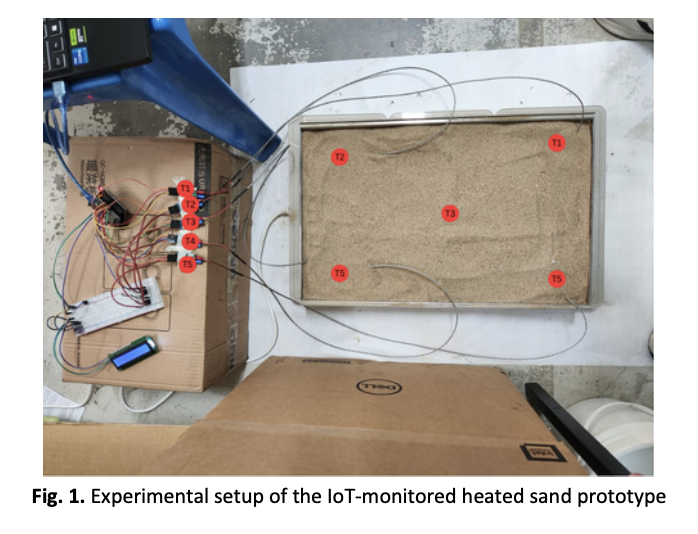
Sand layer thickness for artificially heated reptile habitats is often chosen without a clear understanding of its effect on heat distribution, creating uncertainty in balancing internal heat retention against surface basking temperature. This study investigates the effect of sand layer thickness on heat distribution and determines the effective thermal properties of a selected sand sample for an artificially heated habitat designed for Uromastyx aegyptia. An Internet of Things (IoT)-based monitoring system using an ESP32 microcontroller, five K-type thermocouples, and a BME280 sensor was developed to acquire temperature, humidity, and ambient data in real time. Two sand thicknesses, 4.5 cm and 5.0 cm, were tested under identical heating conditions for 6.5 hours each. A one-dimensional semi-infinite conduction model was fitted to the experimental data in MATLAB to estimate the effective thermal conductivity, thermal diffusivity, and specific heat capacity. Results show that the 5.0 cm layer exhibited greater internal heat retention, with the average embedded temperature increasing form 69.6 °C for the 4.5 cm layer to 74.5 °C for the 5.0 cm layer, but recorded a lower surface basking temperature than the 4.5 cm layer, highlighting a distinction between bulk heat retention and surface thermal performance relevant to habitat design. However, selecting an appropriate sand layer thickness remains uncertain because different thicknesses can produce different heat distribution, heat retention, and surface temperature responses, while the effective thermal properties of commercially available sand may differ from published values for standardised materials.

Author Biographies

Khaw Zhi Xian, School of Mechanical Engineering, Tuanku Syed Sirajuddin Engineering Campus, Universiti Sains Malaysia, 14300 Nibong Tebal, Pulau Pinang, Malaysia

zhixian@student.usm.my

Mohd Syakirin Rusdi, School of Mechanical Engineering, Tuanku Syed Sirajuddin Engineering Campus, Universiti Sains Malaysia, 14300 Nibong Tebal, Pulau Pinang, Malaysia

syakirin@usm.my

Muhammad Hafiz Hassan, School of Mechanical Engineering, Tuanku Syed Sirajuddin Engineering Campus, Universiti Sains Malaysia, 14300 Nibong Tebal, Pulau Pinang, Malaysia

mhafizhassan@usm.my

Muhammad Fauzinizam Razali, School of Mechanical Engineering, Tuanku Syed Sirajuddin Engineering Campus, Universiti Sains Malaysia, 14300 Nibong Tebal, Pulau Pinang, Malaysia

mefauzinizam@usm.my

Downloads

Published

2026-10-22

Issue

Section

Articles