Immersion Time Dependence in the Fabrication of Cesium Bismuth Iodide (Cs3Bi2I9) Perovskite Solar Cells (PeSCs) by the Hot Immersion Method
Keywords:
CBI, Immersion time, Perovskite, Solar cells, Hot immersion methodAbstract
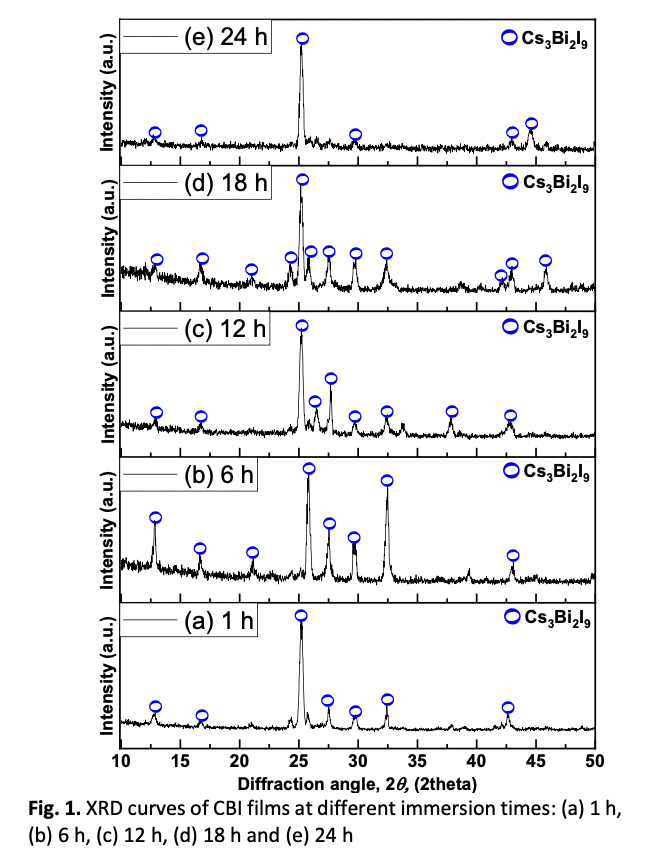
Up to date, lead (Pb)-based perovskite solar cells (PeSCs) were widely discovered due to its outstanding performance, however, it is a toxic and unstable material, while the Cesium (Cs)-based PeSCs is a non-toxic and stable material. In this paper, the hot immersion time (HIT) dependence in the fabrication of cesium bismuth iodide (Cs3Bi2I9-CBI) PeSCs fabricated through the hot immersion method (HIM) is reported. The CBI fabricated using a simple method by changing the hot immersion time between 1 h and 24 h. The XRD results showed that the crystallinity of the CBI film was improved, while the surface morphology showed that the compact and dense film were enhanced. On increasing the HIT, an increase in the average thickness film from 0.918 μm to 4.22 μm was observed. The increase in the thickness led to an extension of band-edge absorption region of CBI film, which is the absorption band-edge region at 647 nm that is extended to 678 nm wavelength with a narrower indirect bandgap, which is from 1.81 eV to 1.65 eV. Consequently, high light absorption of CBI cell due to the high surface roughness, which is 42.33 x 10² nm at 18 h attributed to a better light trap and hence reduced the light reflection effect on the CBI film surface. Eventually, the performance of HIM-fabricated CBI-PeSCs showed an increment, particularly the short-circuit current density (Jsc), which is fourfold increases, i.e., from 3.0 x 10⁻² mA/cm2 to 0.11 mA/cm2, while the open-circuit voltage showed fifteenfold increases, i.e., from 0.008 V to 0.12 V, at 18 h of hot immersion time. Our finding suggests that by using HIM, the electronic properties of CBI-PeSCs are still attainable through a simple method and it can be improved by HIT. Yet providing a low-cost approach for the fabrication of Pb-free PeSCs in future work.
 " SHARE YOUR KNOWLEDGE FOR A BETTER TOMORROW "