Design and Simulation of Soot Blower Lance Tube

Authors

  • Mohd Najmi Sharfudin Plant Engineering Technology (PETech) Section, Malaysian Institute of Industrial Technology, Universiti Kuala Lumpur, 81750 Masai, Johor, Malaysia
  • Munir Faraj Almabrouk Alkbir Plant Engineering Technology (PETech) Section, Malaysian Institute of Industrial Technology, Universiti Kuala Lumpur, 81750 Masai, Johor, Malaysia
  • Rahimah Mahat Advanced Facilities Engineering Technology Research Cluster (AFET), Plant Engineering Technology (PETech) Section, Malaysian Institute of Industrial Technology, Universiti Kuala Lumpur, 81750 Masai, Johor, Malaysia
  • Mohd Al-Fatihhi Mohd Szali Januddi Advanced Facilities Engineering Technology Research Cluster (AFET), Plant Engineering Technology (PETech) Section, Malaysian Institute of Industrial Technology, Universiti Kuala Lumpur, 81750 Masai, Johor, Malaysia
  • Ardiyansyah Syahrom Medical Devices and Technology Centre (MEDITEC), Universiti Teknologi Malaysia (UTM), Skudai, Johor, Malaysia
  • Ab Aziz Mohd Yusof Mechanical Engineering Studies, College of Engineering, Universiti Teknologi MARA Johor Branch, Pasir Gudang Campus, Johor, Malaysia

Keywords:

Lance Tube, Soot Blower, Computational Fluid Dynamic (CFD), Finite Element Analysis (FEA), COMSOL Multiphysics

Abstract

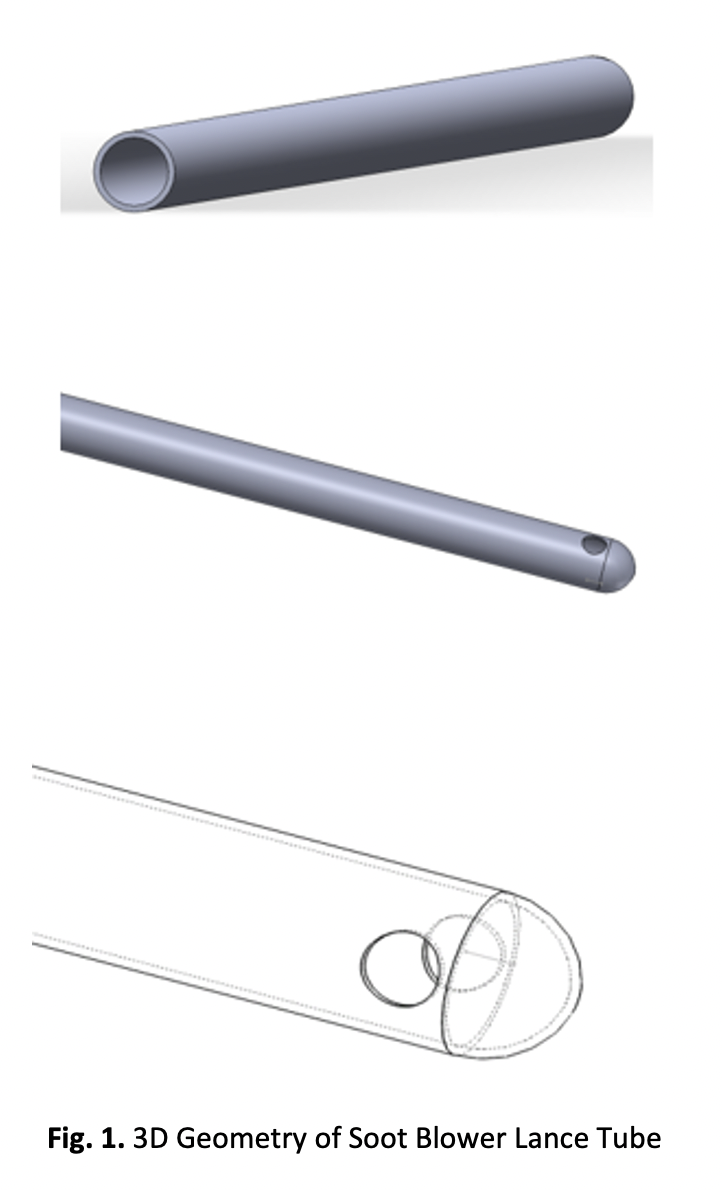
Dependability on soot-blower lance tube design and thickness is very significant for the cleanliness of tube bank boiler in Company A. Major problem in soot blowers was the bending of the lance tube due to external forces, material weakness, and improper balancing. The objectives of this research are to design and simulate as well as to study the heat transfer characteristics of soot blower lance tube. This research starts with 3D geometry modelling, then set up for simulation with Computational Fluid Dynamic (CFD) software (COMSOL Multiphysics) to analyse the heat transfer characteristics. The results for the CFD simulation are velocity and temperature distributions along the soot blower lance tube. The most efficient model was three joint lance tube (3 thickness tube), (11mm (3m long), 7mm (3m long), 5mm (3.2m long)). Then, the most efficient nozzle diameter was 30mm and lastly, the most efficient number of the nozzle was three nozzle holes.  The Finite Element Analysis (FEA) shows these models produced high-velocity distribution and low-temperature distribution.

Downloads

Published

2025-11-05

Issue

Section

Articles