
Clearing the Air: Assessing Air Quality Impact from A Proposed Medical Waste Incinerator Using Gaussian Dispersion Modeling

Authors

  • Ibnu Susanto Joyosemito University of Bhayangkara Jakarta Raya, Kota Bekasi Jawa Barat, Indonesia
  • Sophia Shanti Meilani Universiti Kuala Lumpur, 1080 Jalan Sultan Ismail, Kuala Lumpur, Malaysia
  • Muhammad Azmi Universiti Kuala Lumpur, 1080 Jalan Sultan Ismail, Kuala Lumpur, Malaysia

Keywords:

Ambient Air Quality, Air Dispersion Modeling, Gaussian Modeling, Incinerator, Medical Waste

Abstract

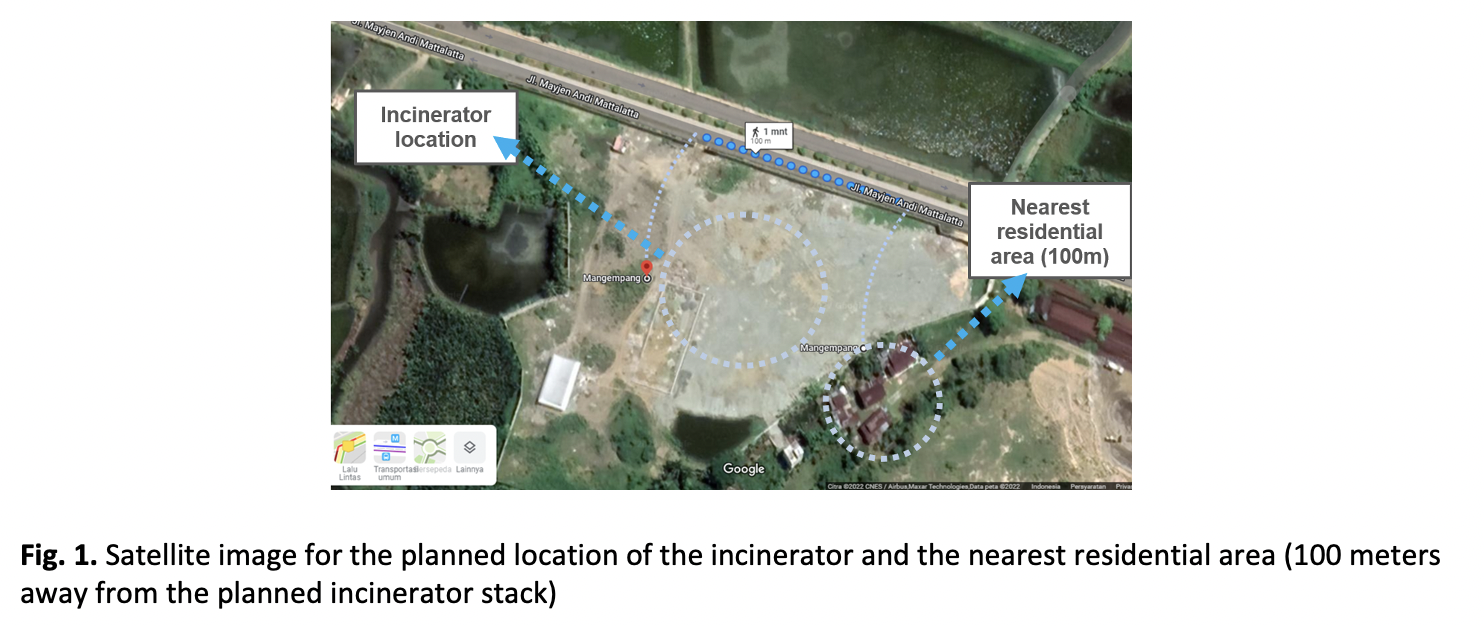
The increase of medical waste is a critical concern in regions grappling with limited infrastructure. Indonesia responds to this challenge by proposing a medical waste incinerator to enhance their waste management practices. However, it is the important to evaluate potential environmental repercussions, in particular air quality degradation. This study employs a Gaussian air dispersion modeling approach to analyse the dispersion patterns and magnitude of air pollutant concentrations emanating from the proposed medical waste incinerator. Our investigation is focused on a nearby existing residential area located 100 meters from the proposed incinerator stack installation to study the immediate impact. The study simulated two atmospheric stability scenarios: 'very unstable' (A) and 'unstable' (B) based on annual meteorological condition at site, highlighting the adherence of five key ambient air quality parameters—Nitrogen Dioxide (NO2), Sulfur Dioxide (SO2), Carbon Monoxide (CO), Total Suspended Particulate (TSP), and Lead (Pb)— against Indonesia's National Ambient Air Quality Standard (INAQS) within both atmospheric stability scenarios. Notably, the concentrations of Pb and NO2, while below INAQS limits, is approaching the threshold levels with peaks of 1.459 µg/m³ and 128.840 µg/m³. Although results comply with local regulation, significance of continuous vigilance in air quality management emerges.

Downloads

Published

2025-11-05

Issue

Section

Articles