
Unveiling the Thermostability, Safety, and In vitro Delivery of Starch-Coated Enriched Palm Kernel Cake Synbiotic Pellets with Immobilized Lactiplantibacillus plantarum ATCC 8014

Authors

  • Nur Ain Syuhada Zamri Section of Food Engineering Technology, Universiti Kuala Lumpur Branch Campus Malaysian Institute of Chemical and Bioengineering Technology, Lot 1988 Vendor City, Taboh Naning, 78000 Alor Gajah, Melaka, Malaysia
  • Abdul Manan Dos Mohamed Section of Food Engineering Technology, Universiti Kuala Lumpur Branch Campus Malaysian Institute of Chemical and Bioengineering Technology, Lot 1988 Vendor City, Taboh Naning, 78000 Alor Gajah, Melaka, Malaysia
  • Siti Fatimah Ibrahim School of Chemical and Process Engineering, University of Leeds, Woodhouse Lane, Leeds, LS2 9JT, England
  • Zuraidah Rasep Advanced Facilities Engineering Technology, Plant Engineering Technology Section, Universiti Kuala Lumpur Branch Campus Malaysian Institute of Industrial Technology, Persiaran Sinaran Ilmu, Bandar Seri Alam, 81750 Johor Bahru, Johor, Malaysia
  • Mohd Anuar Ismail Advanced Facilities Engineering Technology, Plant Engineering Technology Section, Universiti Kuala Lumpur Branch Campus Malaysian Institute of Industrial Technology, Persiaran Sinaran Ilmu, Bandar Seri Alam, 81750 Johor Bahru, Johor, Malaysia
  • Nurul Syazmeen Saiful Rijal Advanced Facilities Engineering Technology, Plant Engineering Technology Section, Universiti Kuala Lumpur Branch Campus Malaysian Institute of Industrial Technology, Persiaran Sinaran Ilmu, Bandar Seri Alam, 81750 Johor Bahru, Johor, Malaysia
  • Shahrulzaman Shaharuddin Advanced Facilities Engineering Technology, Plant Engineering Technology Section, Universiti Kuala Lumpur Branch Campus Malaysian Institute of Industrial Technology, Persiaran Sinaran Ilmu, Bandar Seri Alam, 81750 Johor Bahru, Johor, Malaysia

Keywords:

Feed Additive, In vitro delivery, Pellet, Thermostability, Toxicity

Abstract

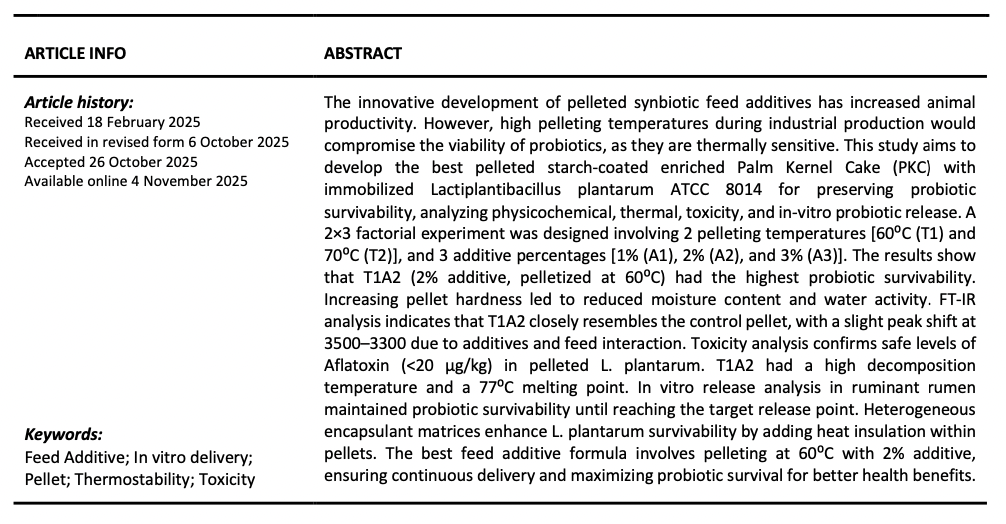
The innovative development of pelleted synbiotic feed additives has increased animal productivity. However, high pelleting temperatures during industrial production would compromise the viability of probiotics, as they are thermally sensitive. This study aims to develop the best pelleted starch-coated enriched Palm Kernel Cake (PKC) with immobilized Lactiplantibacillus plantarum ATCC 8014 for preserving probiotic survivability, analyzing physicochemical, thermal, toxicity, and in-vitro probiotic release. A 2×3 factorial experiment was designed involving 2 pelleting temperatures [60⁰C (T1) and 70⁰C (T2)], and 3 additive percentages [1% (A1), 2% (A2), and 3% (A3)]. The results show that T1A2 (2% additive, pelletized at 60⁰C) had the highest probiotic survivability. Increasing pellet hardness led to reduced moisture content and water activity. FT-IR analysis indicates that T1A2 closely resembles the control pellet, with a slight peak shift at 3500–3300 due to additives and feed interaction. Toxicity analysis confirms safe levels of Aflatoxin (<20 μg/kg) in pelleted L. plantarum. T1A2 had a high decomposition temperature and a 77⁰C melting point. In vitro release analysis in ruminant rumen maintained probiotic survivability until reaching the target release point. Heterogeneous encapsulant matrices enhance L. plantarum survivability by adding heat insulation within pellets. The best feed additive formula involves pelleting at 60⁰C with 2% additive, ensuring continuous delivery and maximizing probiotic survival for better health benefits.

Downloads

Published

2025-11-05

Issue

Section

Articles