
Experiencing the effect of dimple diameter on heat transfer characteristics of a tube using (Al2O3 and CuO)/H2O nanofluids (NFs)

Authors

  • Syed Awais Ali Department of Mechanical Engineering, Universiti Teknologi Petronas, Petronas, 32610 Bandar Seri Iskandar, Perak Darul Ridzuan, Malaysia
  • Khairul Habib Department of Mechanical Engineering, Universiti Teknologi Petronas, Petronas, 32610 Bandar Seri Iskandar, Perak Darul Ridzuan, Malaysia
  • Amirul Imran Mohd Sopian Department of Mechanical Engineering, Universiti Teknologi Petronas, Petronas, 32610 Bandar Seri Iskandar, Perak Darul Ridzuan, Malaysia
  • Likhan das Department of Industrial and Manufacturing Systems Engineering, Iowa State University,515 Morrill Road, Iowa, Ames, 50011, USA

Keywords:

dimple tube, heat transfer, nanofluids

Abstract

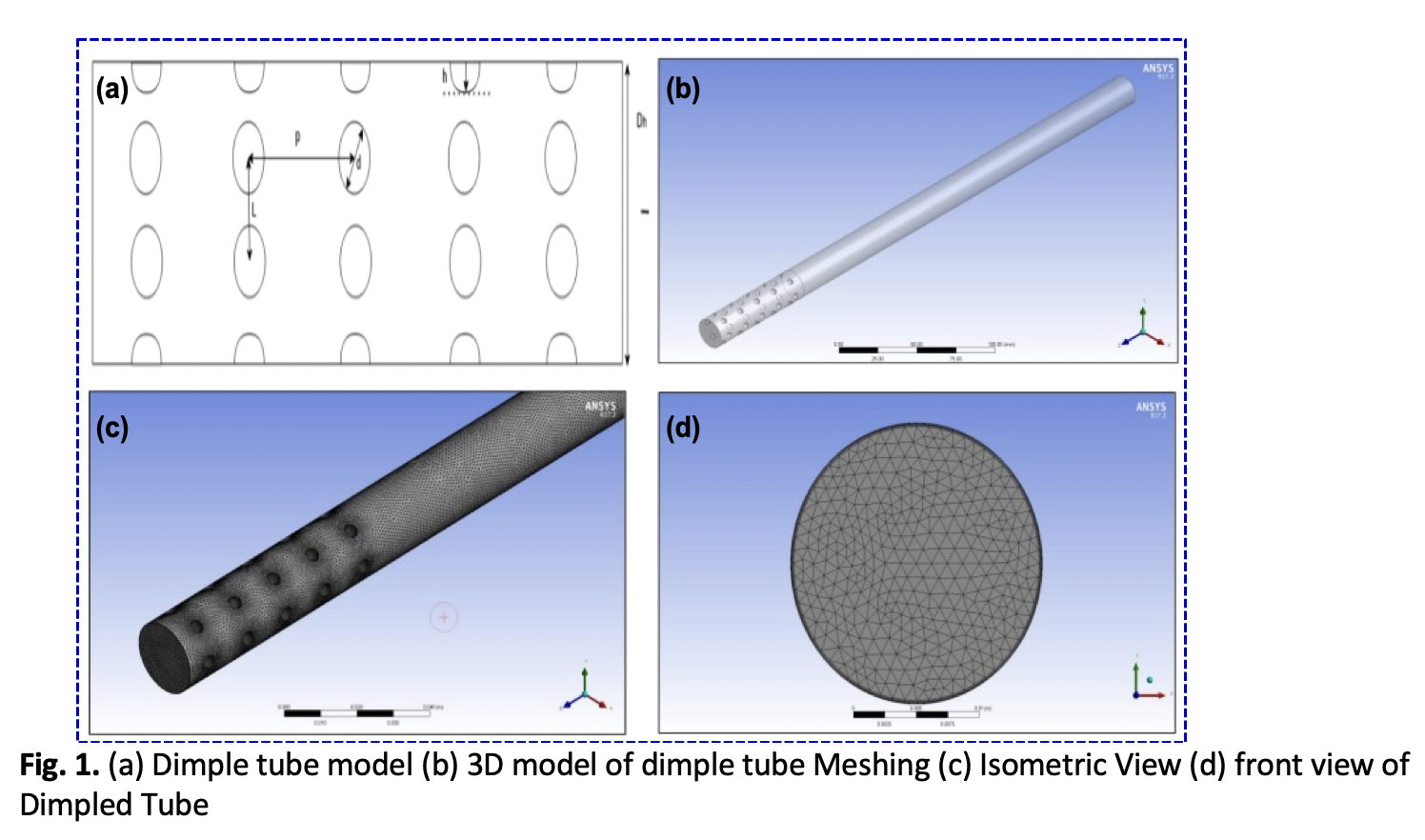
Enhancing the heat transfer in heat exchangers is crucial for various industrial applications. One promising approach is the use of dimpled tubes containing nanofluids (NFs). This study investigates the effect of different dimple diameters on the heat transfer characteristics of dimpled tubes using NFs, aiming to improve the thermal performance of heat exchangers. Numerical simulations were conducted in ANSYS Fluent 17.2 to analyze the friction factor and Performance Evaluation Criteria (PEC), assessing the feasibility of employing dimpled tubes with NFs. Water was selected as the base fluid, with CuO and Al2O3 nanoparticles (NPs) of 30 nm diameter. The simulations were performed under low turbulent flow conditions, with Reynolds numbers ranging from 2500 to 6000. The study examined the impact of three dimple diameters (1 mm, 2 mm, and 4 mm) and varying NF concentrations (0.1%, 0.3%, and 0.5%) for both CuO/H2O and Al2O3/H2O NFs. Results indicated that increasing dimple diameter enhances both the Nusselt number and friction factor. Although PEC also increased, higher Reynolds numbers led to reduced heat exchanger efficiency. Among the NFs, Al2O3/H2O demonstrated superior heat transfer properties and overall performance. Increasing NFs volume fraction up to 0.5% further improved the Nusselt number and PEC. The optimal configuration was achieved with a 4 mm dimple diameter and 0.5% Al2O3/H2O at a Reynolds number of 2500, yielding the highest PEC value of 3.77.

Author Biographies

Syed Awais Ali, Department of Mechanical Engineering, Universiti Teknologi Petronas, Petronas, 32610 Bandar Seri Iskandar, Perak Darul Ridzuan, Malaysia

SYED_22009995@utp.edu.my

Khairul Habib, Department of Mechanical Engineering, Universiti Teknologi Petronas, Petronas, 32610 Bandar Seri Iskandar, Perak Darul Ridzuan, Malaysia

Kharul.habib@utp.edu.my

Amirul Imran Mohd Sopian, Department of Mechanical Engineering, Universiti Teknologi Petronas, Petronas, 32610 Bandar Seri Iskandar, Perak Darul Ridzuan, Malaysia

amirul01@gmail.com

Likhan das, Department of Industrial and Manufacturing Systems Engineering, Iowa State University,515 Morrill Road, Iowa, Ames, 50011, USA

likhan.das01@gmail.com

Downloads

Published

2025-12-08

Issue

Section

Articles