
Numerical investigation of heat transfer enhancement and flow characteristics of nanofluid around two tandem cylinders

Authors

  • Ridha Mebrouk Department of Drilling and Oil Mechanics Building, University of kasdi Maerbah Ouargla, 30000 Ouargla, Algeria
  • Issam Rezaiguia Department of Drilling and Oil Mechanics Building, University of kasdi Maerbah Ouargla, 30000 Ouargla, Algeria
  • Mahfoud Kadja Laboratory of Renewable Energies and Sustainable Development, Department of Mechanical Engineering, University of Frères Mentouri,25000 Constantine, Algeria
  • Aissa Abidi Saad Department of Drilling and Oil Mechanics Building, University of kasdi Maerbah Ouargla, 30000 Ouargla, Algeria

DOI:

https://doi.org/10.37934/arfmts.137.1.117

Keywords:

Computational Fluid Dynamics (CFD), Nanofluid, Vortex shedding, Heat transfer, Nusselt number, Drag coefficient, Lift coefficient

Abstract

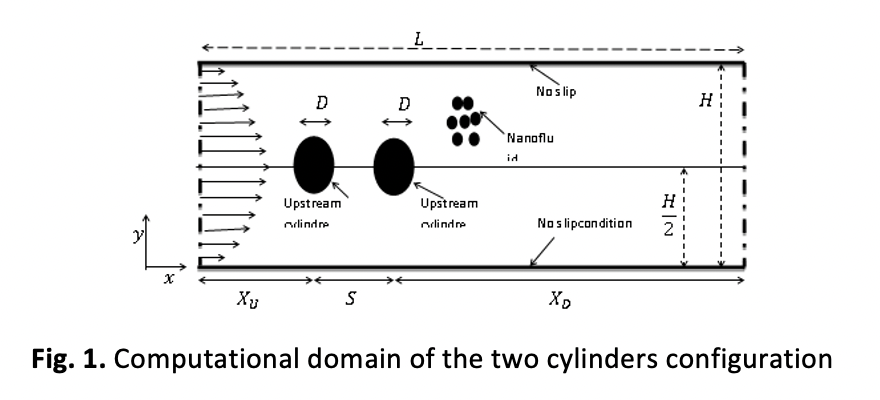
This study presents a numerical investigation of unsteady laminar flow and convective heat transfer of a Cu–water nanofluid, modeled using a single-phase homogeneous approach, around two tandem circular cylinders placed in a semi-confined channel. The unsteady laminar flow is simulated using the finite volume method implemented in ANSYS Fluent. The working fluid is a Cu–water nanofluid with a Prandtl number of 7, and nanoparticle volume fractions ranging from 0% to 6%, while the Reynolds number is fixed at 100. The study examines various center-to-center spacing ratios between 2 and 5, keeping the blockage ratio constant at 0.25. Detailed analyses of the flow and thermal fields are performed using streamlines, vorticity contours, and temperature distributions. The results indicate that both the spacing ratio and nanoparticle concentration strongly influence the hydrodynamic forces and heat transfer characteristics. At a nanoparticle volume fraction of 6%, the average Nusselt number is enhanced by approximately 8% for the upstream cylinder and 28% for the downstream cylinder compared to pure water. The enhancement becomes more significant at larger cylinder separations, whereas the critical spacing ratio, around 3.9D, remains essentially unchanged when the base fluid is replaced with the nanofluid. These findings offer valuable insight into how nanoparticle loading and cylinder spacing can be optimized to improve convective heat transfer in compact heat exchanger applications. It should be noted that the nanofluid is treated as a homogeneous fluid with constant thermophysical properties, which neglects possible particle slip, agglomeration, and non-uniform distribution effects.

Author Biographies

Ridha Mebrouk, Department of Drilling and Oil Mechanics Building, University of kasdi Maerbah Ouargla, 30000 Ouargla, Algeria

Issam Rezaiguia, Department of Drilling and Oil Mechanics Building, University of kasdi Maerbah Ouargla, 30000 Ouargla, Algeria

Mahfoud Kadja, Laboratory of Renewable Energies and Sustainable Development, Department of Mechanical Engineering, University of Frères Mentouri,25000 Constantine, Algeria

Aissa Abidi Saad, Department of Drilling and Oil Mechanics Building, University of kasdi Maerbah Ouargla, 30000 Ouargla, Algeria

Downloads

Published

2026-01-20

Issue

Section

Articles