Boiler Performance Analysis Reviewed from Natural Gas Consumption and Steam Production at Fluctuating and Stable Operating Conditions at PT Petrokimia Gresik’s Sulfuric Acid and Utility Units
Keywords:
Boiler efficiency, natural gas, fluctuating load, specific fuel consumption, steam productionAbstract
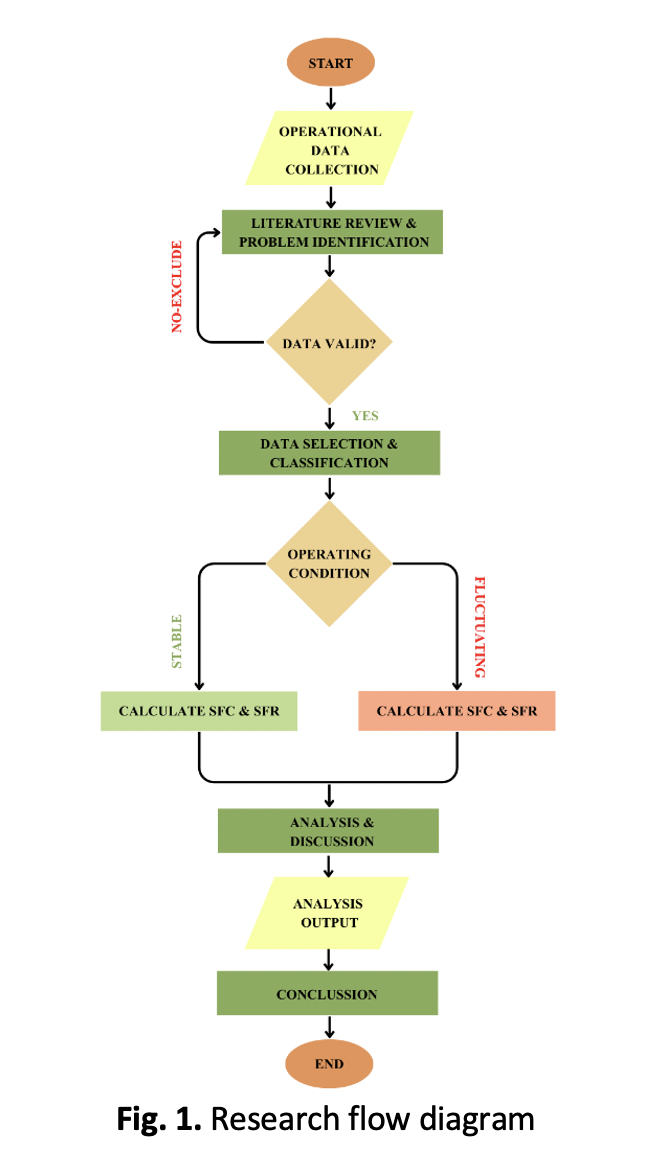
Boilers are a critical component in the chemical industry's utility system that functions to provide thermal energy through steam production. Fluctuating fuel supply and varying steam load conditions significantly affect boiler performance, yet systematic evaluation under such conditions remains limited in industrial settings. This study aims to analyze the performance of Boiler B6201 at the Sulfuric Acid and Utility Unit of PT Petrokimia Gresik over the period September–December 2025. Performance was evaluated under fluctuating and stable operating conditions based on natural gas consumption and steam production data. Parameters analyzed include Specific Fuel Consumption, Steam-to-Fuel Ratio, and 7-day Rolling Coefficient of Variation of gas consumption as an objective classifier of operating stability. Operational data were obtained from daily and hourly logsheets covering gas flow inlet, air flow, boiler feed water, and steam outlet temperature and pressure. October 2025 recorded the most stable conditions with a Coefficient of Variation of 12.89%, the best Specific Fuel Consumption of 2.4401 Kilo Standard Cubic Feet per ton (Kscfh/ton), and the highest Steam-to-Fuel Ratio of 0.4157 tons/Kscfh. November 2025 recorded the most volatile conditions with a Coefficient of Variation of 43.78% and the worst Specific Fuel Consumption of 3.3449 Kscfh/ton. A 36.5% decrease in steam production was not followed by a proportionate decrease in gas consumption, as most energy was absorbed to maintain boiler operating pressure and temperature. Fluctuating conditions were therefore 26.2% more fuel-wasteful than stable conditions. This disproportionate relationship is an inherent consequence of boiler thermal characteristics, and efficiency improvements require better coordination of steam load management at the utility system level.
 " SHARE YOUR KNOWLEDGE FOR A BETTER TOMORROW "