
Stability analysis of Joule heating and viscous dissipation effects on micropolar nanofluid flow over nonlinear stretching/shrinking surface

Authors

  • Khuram Rafique Centre of Excellence for Social Innovation and Sustainability, Institute of Engineering Mathematics, University Malaysia Perlis, Arau, Perlis, Malaysia
  • Tatheer Fatima Department of Mathematics, University of Sialkot, Pakistan
  • Gamal Elkahlout School of Business Studies, Arab Open University, Riyadh, Saudi Arabia

DOI:

https://doi.org/10.37934/arfmts.138.1.114

Keywords:

micropolar nanofluid, Joule heating, viscous dissipation, stretching/shrinking surface, stability analysis, BVP4C

Abstract

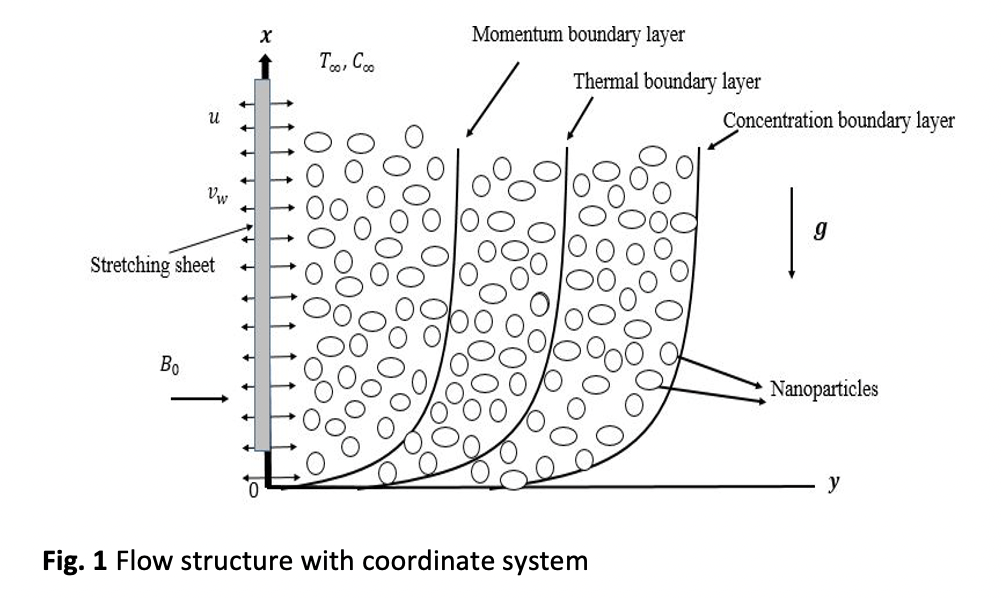
In these days, due to the demand of compact systems the heat dissipation rate is subject under discussion. Water cooling systems and air cooling systems are not that much suitable in tiny systems sue to their structure. Therefore, using of nanofluids for heating and cooling is preferred in industries, and by minimizing the structure of the system, cost may also be minimized. By increasing the rate of energy transmission, nanoliquids aids in strengthen the performance of thermal systems. Nanoliquids are widely employed in many different applications including gasoline, automotive coolant and medical and electrical equipment to lower heat resistance. In view of these applications, the main goal of this research is to study the energy and mass transmission of micropolar nanofluid flow through a vertical surface by incorporating viscous dissipation and Joule heating effects. The flow model converted into nonlinear ODE’s via similarity variables. Furthermore triple solutions are derived via MATLAB BVP4C package. Moreover, examination is performed to evaluate their stability. The investigation showed that only first result is stable remaining two are unstable. The results reported that the temperature distribution shows increasing behavior for the increment in Eckert number. While the velocity of the liquid slow down on the increment in magnetic strength. In the same vein the temperature distribution decreases for the increment in Brownian factor.

Author Biography

Gamal Elkahlout, School of Business Studies, Arab Open University, Riyadh, Saudi Arabia

g.elkahlout@arabou.edu.sa

Downloads

Published

2026-02-28

Issue

Section

Articles