

Enhancing the Resilience of Deep Learning Models for Agricultural Applications: A Study on Adversarial Robustness

Authors

  • Tahajib Jakir Khan Department of Computer Science and Engineering, Faculty of Science and Information Technology, Daffodil International University, Dhaka 1216, Bangladesh
  • Prosenjit Chandra Biswas Department of Computer Science and Engineering, Faculty of Science and Information Technology, Daffodil International University, Dhaka 1216, Bangladesh
  • Jannatul Ferdous Momo Department of Computer Science and Engineering, Faculty of Science and Information Technology, Daffodil International University, Dhaka 1216, Bangladesh
  • Rafiul Islam Department of Computer Science and Engineering, Faculty of Science and Information Technology, Daffodil International University, Dhaka 1216, Bangladesh
  • Sazzadur Rahman Department of Computer Science and Engineering, Faculty of Science, University of Dhaka, Dhaka 1000, Bangladesh
  • Shah Md. Tanvir Siddiquee Department of Computer Science and Engineering, Faculty of Science and Information Technology, Daffodil International University, Dhaka 1216, Bangladesh

DOI:

https://doi.org/10.37934/araset.55.1.292311

Keywords:

CNN-LSTM Hybrid Model, Adversarial Robustness, Betel Leaf Disease Classification, PGD Adversarial Attack, Deep Learning in Agriculture

Abstract

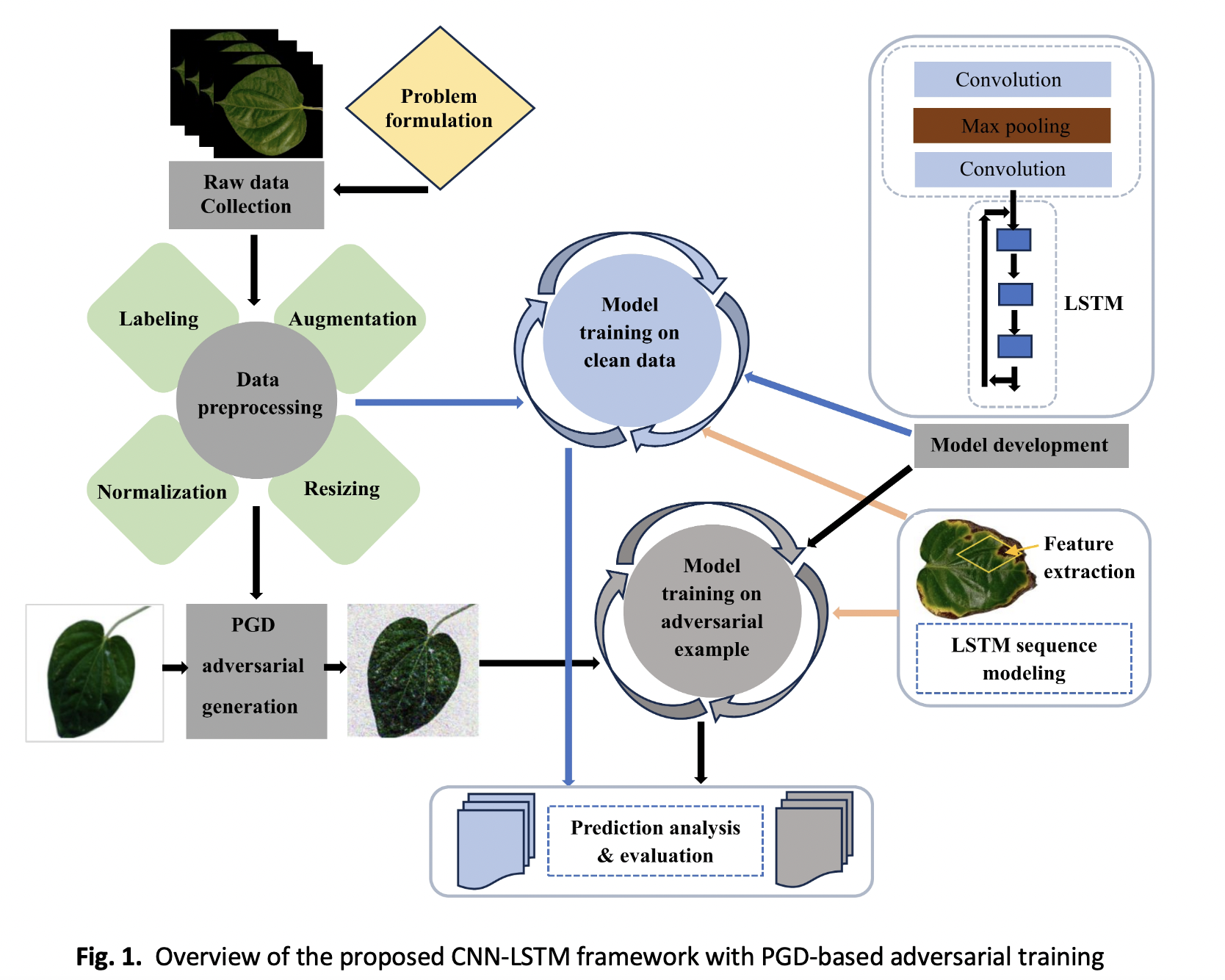
Early and accurate detection of plant diseases is crucial for maintaining crop health and ensuring agricultural productivity. This study investigates the classification of betel leaf and vine diseases using a hybrid Convolutional Neural Network-Long Short-Term Memory (CNN-LSTM) architecture, designed to capture spatial patterns and model structured spatial dependencies by treating CNN-extracted feature representations as ordered sequences within static leaf and vine images, rather than temporal dynamics. To address vulnerabilities to adversarial perturbations, which can mislead standard deep learning models even with visually imperceptible changes, this work incorporates adversarial training based on the Projected Gradient Descent (PGD) method. A curated dataset of betel leaf images, including both natural and adversarially perturbed samples, is used to train and evaluate the model. Experimental results demonstrate that the adversarially trained CNN-LSTM  maintains high classification accuracy 96.96%, achieves F1-score of 96.25%, and robustness accuracy under PGD attacks of 92.19%. Class-wise analyses using precision, recall, and F1-score confirm balanced performance across all disease categories, highlighting the model’s reliability under challenging input conditions. These findings underscore the importance of integrating robustness-focused strategies in deep learning systems for plant disease detection and provide insights that can guide the development of more robust AI solutions for agricultural imaging applications, while future work is required to assess performance under field conditions and deployment constraints.

Author Biography

Tahajib Jakir Khan, Department of Computer Science and Engineering, Faculty of Science and Information Technology, Daffodil International University, Dhaka 1216, Bangladesh

Jakir15-14503@diu.edu.bd

Downloads

Published

2026-01-14

Issue

Section

Articles