Thermal Properties and Phase Transformation Behaviour of Az91–Cnt Magnesium Nanocomposites
Keywords:
AZ91 magnesium alloy, carbon nanotube reinforcement, differential scanning calorimetry, phase transformation behaviour, thermal stabilityAbstract
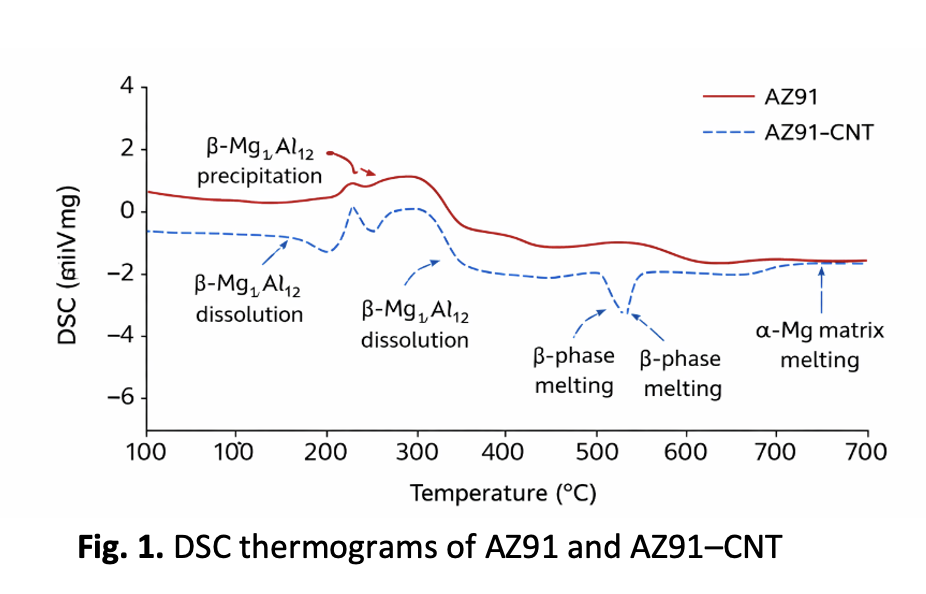
Magnesium alloys are widely utilised in lightweight structural applications; however, their application in temperature-sensitive environments is limited by poor thermal stability and phase transformation behaviour at elevated temperatures. In AZ91 magnesium alloy, instability of the β-Mg₁₇Al₁₂ intermetallic phase at intermediate temperatures can lead to degradation of mechanical performance during service. Therefore, this study aims to investigate the effect of carbon nanotube (CNT) reinforcement on the thermal properties and phase transformation behaviour of AZ91 magnesium alloy. AZ91–CNT nanocomposites were fabricated using the powder metallurgy method and compared directly with unreinforced AZ91 alloy. Differential Scanning Calorimetry was employed to analyse thermal events associated with β-Mg₁₇Al₁₂ precipitation, dissolution, and melting during heating. The results show that CNT reinforcement causes a noticeable shift of β-phase dissolution to higher temperatures and a reduction in transformation enthalpy compared to the unreinforced alloy. These changes indicate enhanced phase stability and modified thermodynamic and kinetic behaviour due to the presence of CNTs. The CNTs are suggested to act as diffusion barriers and interfacial modifiers, restricting aluminium diffusion and delaying phase transformation processes. Significant modification of thermal behaviour was observed within the temperature range of 380–450 °C, which is critical for magnesium alloy applications subjected to thermal exposure. In conclusion, CNT reinforcement effectively enhances the thermal stability of AZ91 magnesium alloy by altering β-phase transformation behaviour, providing important insight into CNT–matrix interactions and supporting the development of thermally stable AZ91-based nanocomposites for temperature-sensitive engineering applications.