
Fractional Flow Reserve of Non-Newtonian Blood Flow in a Stenosed Bifurcated Artery

Authors

  • Kannigah Thirunanasambantham Department of Mathematical Sciences, Faculty of Science, Universiti Teknologi Malaysia, 81310, Malaysia
  • Siti Nor Hasimah Hamid Department of Mathematical Sciences, Faculty of Science, Universiti Teknologi Malaysia, 81310, Malaysia
  • Zuhaila Ismail Department of Mathematical Sciences, Faculty of Science, Universiti Teknologi Malaysia, 81310, Malaysia
  • Lim Yeou Jiann Department of Mathematical Sciences, Faculty of Science, Universiti Teknologi Malaysia, 81310, Malaysia
  • Amnani Shamjuddin Chemical Reaction Engineering Group (CREG), Faculty of Chemical and Energy Engineering, Universiti Teknologi Malaysia, 81310, Malaysia
  • Yahaya Shagaiya Daniel Department of Mathematical Sciences, Faculty of Science, Kaduna State University, Nigeria

Abstract

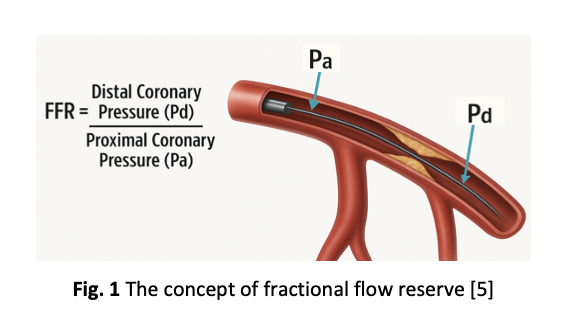
Coronary artery stenosis alters blood flow, increasing the risk of myocardial ischemia. This study explores the impact of four plaque formations on fractional flow reserve in a bifurcated artery using COMSOL Multiphysics. Blood is modelled as a non-Newtonian fluid via a generalised power-law, with rigid arterial walls representing diseased vessels. Hybrid nanofluids and magnetohydrodynamic effects are included. Under hyperemic conditions, pressure gradients across stenosed regions are analysed to compute fractional flow reserve. Results show that plaque geometry and distribution significantly affect fractional flow reserve: simpler bifurcations maintain higher fractional flow reserve, while complex geometries reduce and destabilise it. Magnetic fields help stabilise flow and slightly improve fractional flow reserve in narrowed areas. Hybrid nanofluids enhance fractional flow reserve in wider vessels but may reduce it in tighter regions due to increased viscosity. These findings support the integration of advanced fluid models and electromagnetic effects for more accurate cardiovascular diagnostics.

Author Biography

Zuhaila Ismail, Department of Mathematical Sciences, Faculty of Science, Universiti Teknologi Malaysia, 81310, Malaysia

zuhaila@utm.my

Downloads

Published

2026-02-09

Issue

Section

Articles