Development of a Higher Order Numerical Wave Tank for Internal Waves
Keywords:
Finite difference method, arbitrary-order numerical scheme, sigma-coordinate transformation, numerical simulation, two-dimensional, velocity potentialAbstract
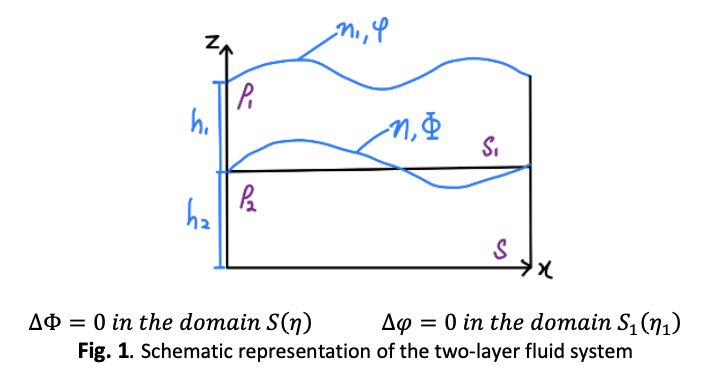
Internal waves, particularly internal solitary waves (ISW), play a significant role in ocean dynamics and have substantial implications for offshore structures and underwater operations. The South China Sea is a region where ISW is frequently observed, posing challenges to offshore platforms, submarine navigation, and underwater infrastructure. However, accurate numerical modelling of ISW remains limited due to computational inefficiencies and a lack of publicly available simulation tools. This study presents the development of a higher-order numerical wave tank for simulating internal waves in a double-layer wave system under the rigid lid approximation. The model employs a finite difference method (FDM) combined with a sigma-coordinate transformation, enabling computations to be performed on a fixed two-dimensional grid despite spatial variations in the velocity potential, ϕ. An arbitrary-order stencil was implemented, allowing the numerical accuracy to be tuned according to specific real-world problem requirements. The numerical model builds upon previous work that lacked an open-source implementation. The velocity potential was solved as an intermediate step to derive the two-dimensional velocity field. With the application of the known boundary conditions, the combined-layer numerical model demonstrated satisfactory performance when validated against established benchmark test cases, with results aligning well within the understandable error margins. To further contribute to future research, the model was structured as an open source for reuse within the research group. Future development will focus on adopting second-order wave theory, removing the rigid lid approximation, and extending the model to three-dimensional configurations. These improvements bridge the gap between numerical simulations and the real-world dynamics of internal waves.