
Optimization of Stable Water–Oil Emulsified Samples for Hydrate–Wax Interaction Studies

Authors

  • Mohd Zaki Zainal Abidin Faculty of Chemical Engineering, Universiti Teknologi MARA (UiTM) Terengganu, Bukit Besi Campus, Dungun, Terengganu Darul Iman, Malaysia
  • Rozana Azrina Sazali Faculty of Chemical Engineering, Universiti Teknologi MARA (UiTM) Shah Alam, Selangor Darul Ehsan, Malaysia
  • Azlinda Azizi Faculty of Chemical Engineering, Universiti Teknologi MARA (UiTM) Shah Alam, Selangor Darul Ehsan, Malaysia
  • Uzma Ultasha Mohamad Faculty of Chemical Engineering, Universiti Teknologi MARA (UiTM) Shah Alam, Selangor Darul Ehsan, Malaysia
  • Ihsan Almunawar Abas Faculty of Chemical Engineering, Universiti Teknologi MARA (UiTM) Shah Alam, Selangor Darul Ehsan, Malaysia
  • Nurin Atiqah Zulkifli Faculty of Chemical Engineering, Universiti Teknologi MARA (UiTM) Shah Alam, Selangor Darul Ehsan, Malaysia
  • Nurul Athiraa Mohd Rozi Faculty of Chemical Engineering, Universiti Teknologi MARA (UiTM) Shah Alam, Selangor Darul Ehsan, Malaysia
  • Nur Syamielia Sofi Faculty of Chemical Engineering, Universiti Teknologi MARA (UiTM) Shah Alam, Selangor Darul Ehsan, Malaysia
  • Muhammad Rifaie Rusydi Faculty of Chemical Engineering, Universiti Teknologi MARA (UiTM) Shah Alam, Selangor Darul Ehsan, Malaysia

Keywords:

Hydrate clathrate, wax precipitation, emulsion stability, bottle stability test

Abstract

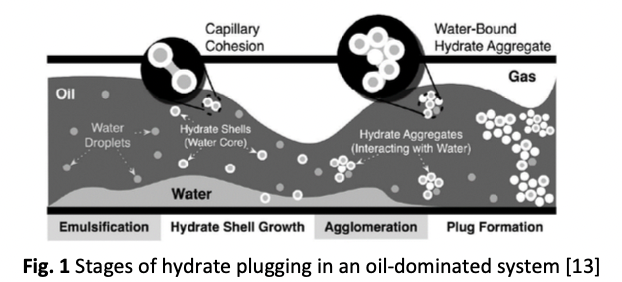
Hydrate and wax plugging pose major challenges in petroleum production, leading to flow disruption, blockages, and safety risks. In oil-dominated systems, emulsions are commonly formed, with hydrates developing at the interfaces of dispersed water droplets and wax precipitating concurrently within the continuous oil phase. These emulsions strongly influence hydrate–wax interactions, yet the role of emulsion characteristics remains underexplored. Achieving emulsion stability is important to ensure complete hydrate conversion and proper interaction with precipitated wax. However, optimum stability is difficult to evaluate, as multiple physical and chemical factors are interrelated. In this study, synthetic emulsions were prepared by dissolving octadecane (C18) in heptane and emulsifying with water using Span 85 and Tween 85. The main objective was to generate stable emulsions that facilitated complete hydrate formation, while systematically evaluating the effects of surfactant concentration, surfactant type, wax ratio, and solvent type. Stability was evaluated using the bottle test, with viscosity and droplet size as supporting measures. Ten samples were prepared with varying formulations. Results showed wax content had the strongest impact: the 60:40 heptane:C18 sample maintained a stable emulsion for one hour, while the 80:20 ratio showed ~30% reduction. Higher wax content also increased viscosity (to 17.5 mPa·s), limiting droplet coalescence. Although interfacial tension suggested reduced stability, the findings confirmed that long-chain paraffinic components enhance stability even before wax precipitation. This study provides a basis for preparing stable emulsified oil–water systems, enabling more reliable hydrate–wax interaction research in flow assurance.

Author Biography

Mohd Zaki Zainal Abidin, Faculty of Chemical Engineering, Universiti Teknologi MARA (UiTM) Terengganu, Bukit Besi Campus, Dungun, Terengganu Darul Iman, Malaysia

zakizainal@uitm.edu.my

Downloads

Published

2026-02-09

Issue

Section

Articles