
Enzymatic Synthesis and Antimicrobial Studies of Ethyl Butyrate: A Short Chain Ester for Fragrance Industry

Authors

  • Muhamad Zikri Yaziz Faculty of Science and Technology, Universiti Sains Islam Malaysia, Bandar Baru Nilai, 71800 Nilai, Negeri Sembilan, Malaysia
  • Salina Mat Radzi Faculty of Science and Technology, Universiti Sains Islam Malaysia, Bandar Baru Nilai, 71800 Nilai, Negeri Sembilan, Malaysia
  • Muhamad Syamsul Kamar Muhamad Faculty of Science and Technology, Universiti Sains Islam Malaysia, Bandar Baru Nilai, 71800 Nilai, Negeri Sembilan, Malaysia
  • Nur Amalina Mohd Amin Faculty of Science and Technology, Universiti Sains Islam Malaysia, Bandar Baru Nilai, 71800 Nilai, Negeri Sembilan, Malaysia
  • Maryam Mohd Rehan Faculty of Science and Technology, Universiti Sains Islam Malaysia, Bandar Baru Nilai, 71800 Nilai, Negeri Sembilan, Malaysia
  • Nurul Jannah Abd Rahman Tahmidi Centre, Universiti Sains Islam Malaysia, Bandar Baru Nilai, 71800 Nilai, Negeri Sembilan, Malaysia

Keywords:

Enzymatic synthesis, Ethyl Butyrate, antimicrobial, short chain ester, fragrance

Abstract

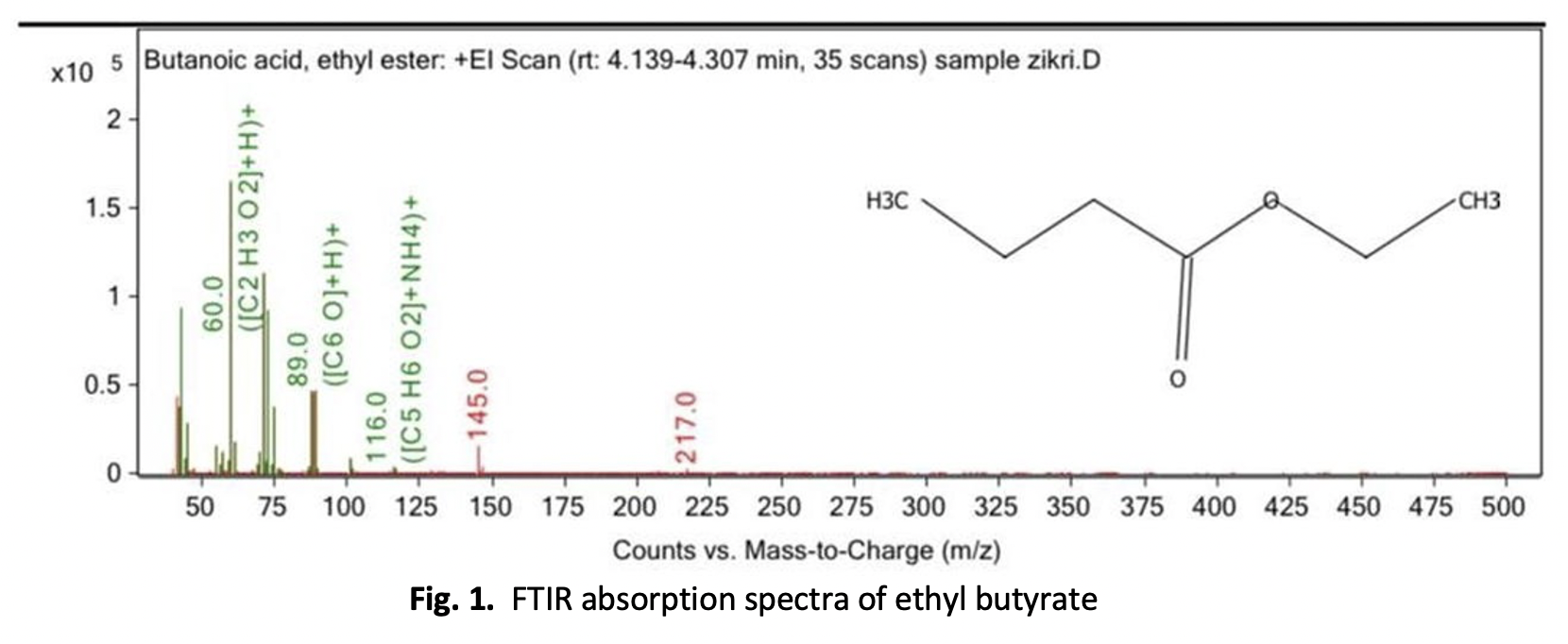
Ethyl butyrate was successfully synthesized via enzymatic esterification of butyric acid and ethanol using immobilized lipase (Novozym 435) as a catalyst. The product was characterized using multiple analytical techniques to confirm its identity and purity. Fourier Transform Infrared (FTIR) spectroscopy revealed a strong absorption band at 1734 cm⁻¹, confirming the presence of the ester carbonyl group (C=O). In the ¹³C Nuclear Magnetic Resonance (NMR) spectrum, distinct peaks at 174.74, 62.63, 35.89, 18.41, and 13.39 ppm indicated the presence of different carbon environments corresponding to the ethyl butyrate structure. Gas Chromatography-Mass Spectrometry (GC-MS) further confirmed the compound’s identity with a molecular ion peak at m/z 116, matching its theoretical molecular mass.The antimicrobial activity of the synthesized ethyl butyrate was evaluated against both Gram-positive and Gramnegative bacteria using the agar diffusion method. Minimum Inhibitory Concentration (MIC) and Minimum Bactericidal Concentration (MBC) values were determined, revealing strong antimicrobial activity particularly against Staphylococcus aureus, Salmonella typhimurium, Escherichia coli, and Bacillus subtilis. MBC/MIC ratios were below 4, suggesting effective bactericidal properties. Additionally, the physicochemical properties of ethyl butyrate were assessed. It showed a Sun Protection Factor (SPF) value of 28, a saponification value of 228, and both iodine and peroxide values of 0. These results comply with industrial safety standards, indicating that the compound is stable and safe for consumer use. Overall, the synthesized ethyl butyrate demonstrated desirable chemical characteristics, notable antimicrobial activity, and physicochemical properties suitable for use in cosmetic or fragrance formulations.

Author Biography

Salina Mat Radzi, Faculty of Science and Technology, Universiti Sains Islam Malaysia, Bandar Baru Nilai, 71800 Nilai, Negeri Sembilan, Malaysia

Downloads

Published

2026-03-04

Issue

Section

Articles