
Predicting Student Project Performance using Machine Learning

Authors

  • Faisal Asad ur Rehman Faculty of Information and Communication Technology, Universiti Tunku Abdul Rahman, 31900, Kampar, Perak, Malaysia
  • Abdulkarim Kanaan Jebna Faculty of Information and Communication Technology, Universiti Tunku Abdul Rahman, 31900, Kampar, Perak, Malaysia
  • Ramesh Kumar Ayyasamy Faculty of Information and Communication Technology, Universiti Tunku Abdul Rahman, 31900, Kampar, Perak, Malaysia
  • Abdelhak Senadjki Teh Hong Piow Faculty of Business and Finance, Universiti Tunku Abdul Rahman, 31900, Kampar, Perak, Malaysia

DOI:

https://doi.org/10.37934/araset.57.5.6781

Keywords:

Digital literacy, entrepreneurial traits, machine learning, project performance, students

Abstract

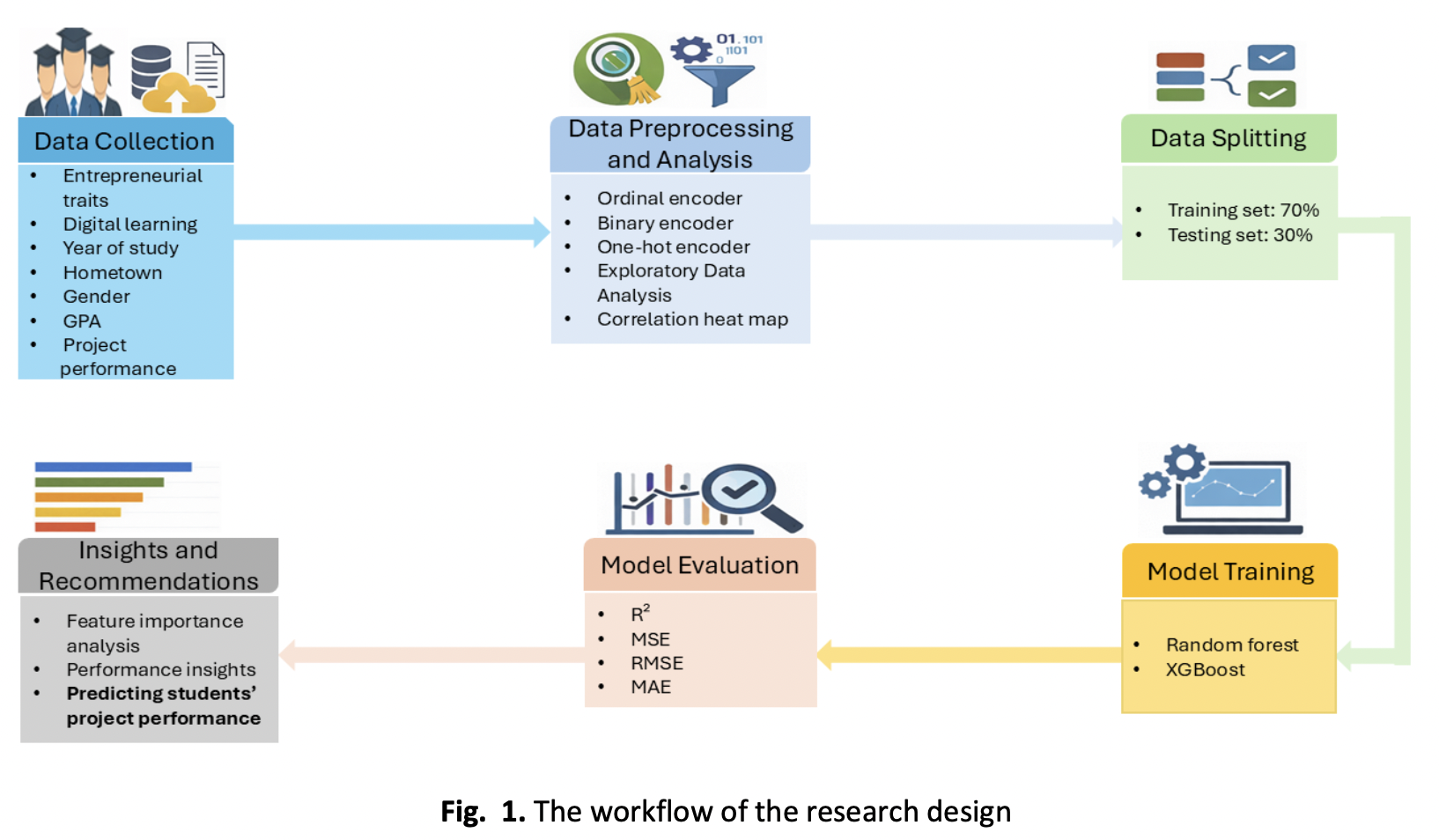
The transition towards Industry 4.0 and digital transformation has increased the demand for graduates equipped with both behavioural and technical competencies to execute complex tasks successfully. While the current project-based curriculum highlights technical proficiency, emerging evidence suggests that entrepreneurial traits and digital literacy significantly enhance project outcomes. However, current students lack these combined skills, creating a gap between industry expectations and workforce capabilities. This challenge reflects evolving demands and limits graduates' employability in advancing today's industries. Motivated by this gap, this research aims to investigate the influence of entrepreneurial traits and digital literacy on students' project performance. A machine learning based data driven framework was proposed in this study to capture complex and hidden relationships. The data were collected from 691 undergraduate students. The results demonstrate that the XGBoost model achieved an average R² of 0.549, with an MSE of 0.444, an RMSE of 0.658, and an MAE of 0.457 under 5-fold cross-validation, showing good predictive capability and low estimation error with a limited dataset. Proactiveness, risk-taking, and digital literacy are the most significant factors in this context. The study recommends that universities redesign the competency-based curricula of their project-based courses to produce skilled graduates ready to work in today's industry.

Author Biographies

Faisal Asad ur Rehman, Faculty of Information and Communication Technology, Universiti Tunku Abdul Rahman, 31900, Kampar, Perak, Malaysia

faisal.asad.rehman1992@gmail.com

Abdulkarim Kanaan Jebna, Faculty of Information and Communication Technology, Universiti Tunku Abdul Rahman, 31900, Kampar, Perak, Malaysia

abdulkarim@utar.edu.my

Downloads

Published

2026-03-18

Issue

Section

Articles