
Effect of Stereolithography (SLA) Machine Printing Parameters on Mechanical Properties and Surface Characteristics of Polylactid Acid (PLA)

Authors

  • Aris Sandi Department of Plantation Industrial Machinery Engineering Technology, Politeknik LPP, Yogyakarta 55222, D.I. Yogyakarta, Indonesia
  • Juan Pratama Department of Mechanical Engineering, Faculty of Engineering, Darma Persada University, East Jakarta 13450, Jakarta, Indonesia
  • Sukmaji Indro Cahyono Department of Mechanical Engineering, Sebelas Maret University, Surakarta 57126, Central Java, Indonesia
  • Urip Agus Salim Department of Mechanical and Industrial Engineering and Centre for Innovation of Medical Equipment and Devices (CIMEDs), Faculty of Engineering, Universitas Gadjah Mada, Sleman 55281, D.I. Yogyakarta, Indonesia
  • Muslim Mahardika Department of Mechanical and Industrial Engineering and Centre for Innovation of Medical Equipment and Devices (CIMEDs), Faculty of Engineering, Universitas Gadjah Mada, Sleman 55281, D.I. Yogyakarta, Indonesia
  • Budi Arifvianto Department of Mechanical and Industrial Engineering and Centre for Innovation of Medical Equipment and Devices (CIMEDs), Faculty of Engineering, Universitas Gadjah Mada, Sleman 55281, D.I. Yogyakarta, Indonesia

Keywords:

Layer thickness, Stereolithography, Normal exposure time, Mechanical strength, Surface characterization, Polylactic acid

Abstract

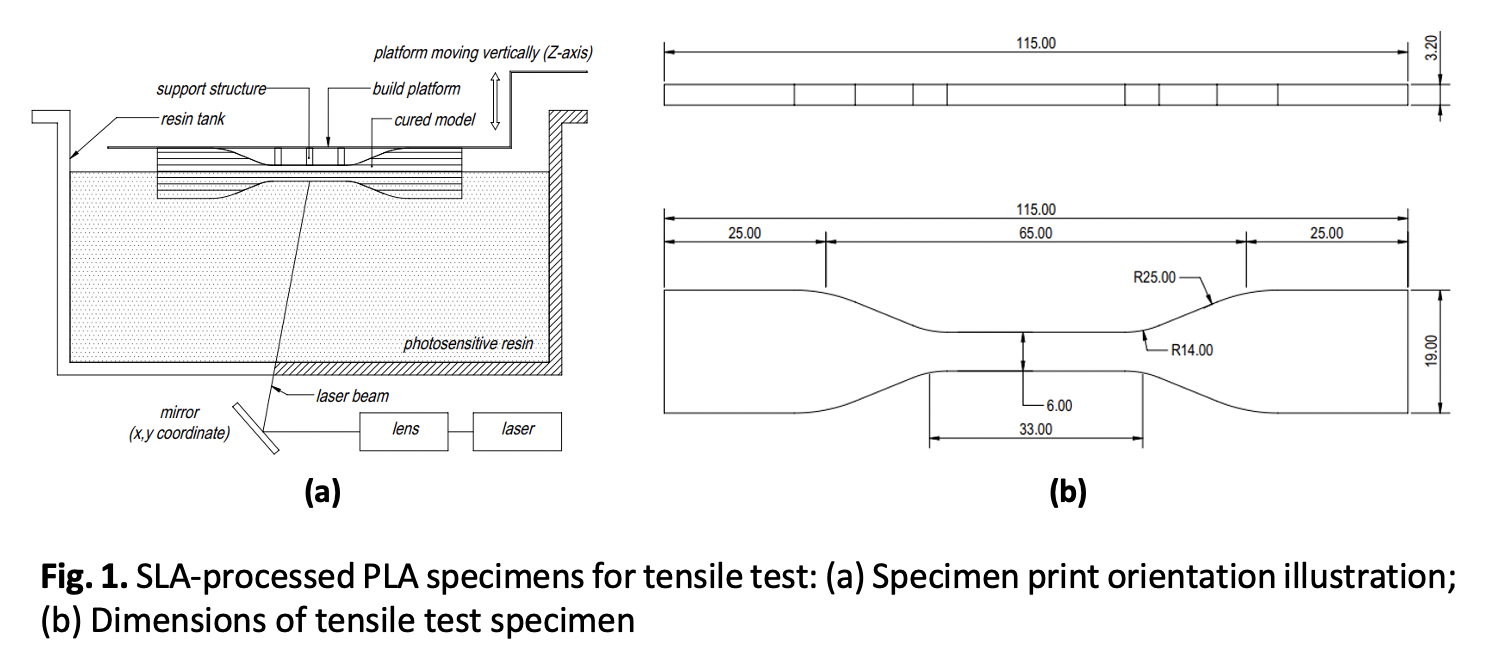
The research aims to investigate the effects of printing parameters on the mechanical properties and surface characteristics of polylactic acid (PLA) material processed by stereolithography. PLA specimens were printed with variable parameters of layer thickness (0.025, 0.05, and 0.075 mm) and normal exposure time (5, 10, and 15 s), while the fixed parameters were a 90° build orientation (transversal, along the X-axis), washing time of 5 min, and curing time of 30 min. Mechanical and surface-characteristics tests were performed on printed specimens to determine the effects of SLA printing parameters on tensile strength, elastic modulus, and surface characteristics. The results showed that the tensile strength, elongation, and surface roughness of the SLA printed specimens were not sensitive to variations in LT and NET in this research except for dimensional accuracy. The combination of LT 0.05 mm and NET 10 seconds produced specimens with the highest mechanical strength, compared with the smaller LT 0.025 mm combined with NET 15 seconds. The similar phenomenon was also observed in the surface roughness test, where a random pattern was observed in the results across various measurement directions (horizontal, vertical, and diagonal). However, the lowest average roughness was obtained with the parameter LT set to 0.025 mm and a NET of 10 seconds. This differs from the pattern of data obtained in the dimensional accuracy test, where the lowest deviation is found in the parameter LT, 0.075 mm, with NET 10 seconds.

Author Biography

Aris Sandi, Department of Plantation Industrial Machinery Engineering Technology, Politeknik LPP, Yogyakarta 55222, D.I. Yogyakarta, Indonesia

aris@polteklpp.ac.id

Downloads

Published

2026-04-09

Issue

Section

Articles