
A Comparative Study on Flood Detection using Deep Learning Techniques

Authors

  • Mohd Shahar Abdullah Malaysia-Japan International Institute of Technology, Universiti Teknologi Malaysia, Jalan Sultan Yahya Petra, Kampung Datuk Keramat, 54100 Kuala Lumpur, Wilayah Persekutuan Kuala Lumpur, Malaysia
  • Ali Selamat Malaysia-Japan International Institute of Technology, Universiti Teknologi Malaysia, Jalan Sultan Yahya Petra, Kampung Datuk Keramat, 54100 Kuala Lumpur, Wilayah Persekutuan Kuala Lumpur, Malaysia
  • Nguyet Quang Do Malaysia-Japan International Institute of Technology, Universiti Teknologi Malaysia, Jalan Sultan Yahya Petra, Kampung Datuk Keramat, 54100 Kuala Lumpur, Wilayah Persekutuan Kuala Lumpur, Malaysia
  • Mohd Azlan Abu Malaysia-Japan International Institute of Technology, Universiti Teknologi Malaysia, Jalan Sultan Yahya Petra, Kampung Datuk Keramat, 54100 Kuala Lumpur, Wilayah Persekutuan Kuala Lumpur, Malaysia

Keywords:

Disaster management, flood detection, image classification, deep learning, pre-trained model

Abstract

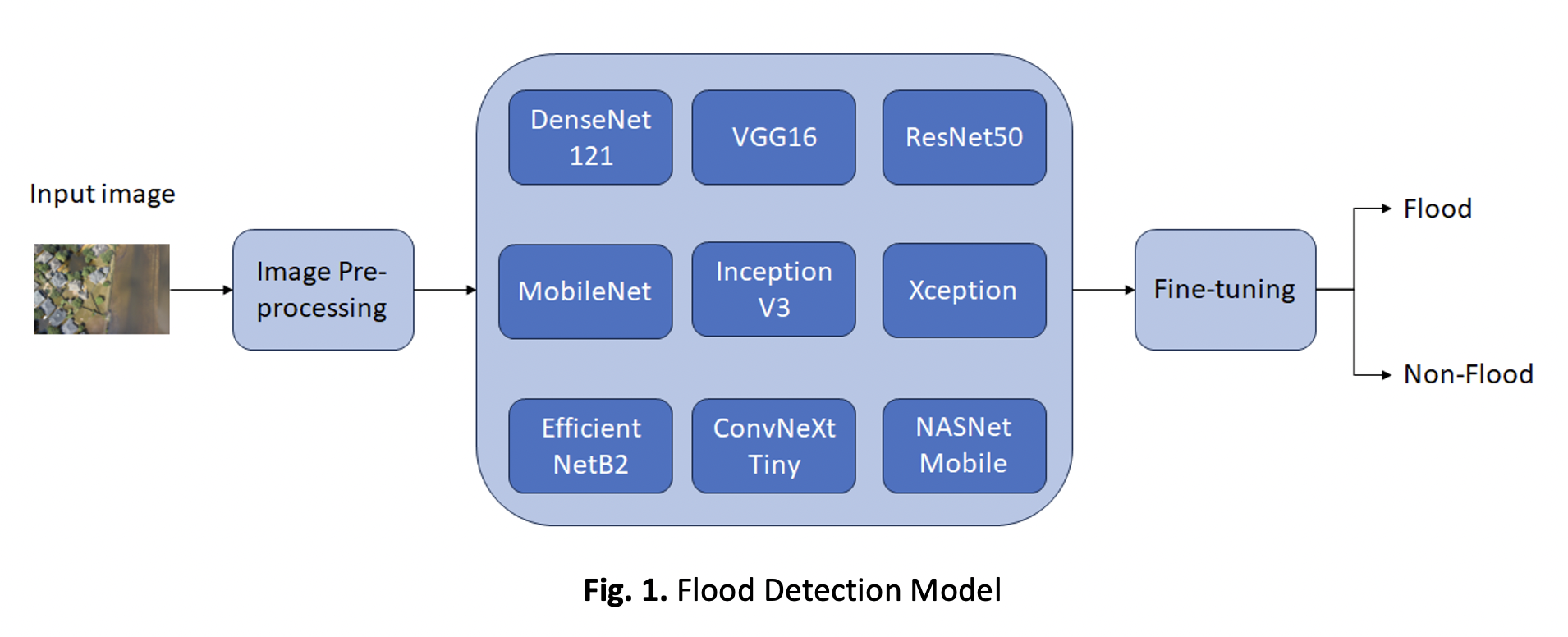
Disasters, both natural and man-made, pose significant threats to societies worldwide, causing devastating losses to life, property, and the environment. The frequency and severity of these events have increased in recent years, partly due to climate change and urbanization. Among natural disasters, flood is one of the most common and destructive calamities. Many solutions have been proposed to mitigate the detrimental impacts of flood. However, traditional measures often struggle to keep pace with the rapid evolution of these crises. Meanwhile, artificial intelligence presents a promising avenue for revolutionizing disaster management. Therefore, this paper aims to provide a comparative study on flood detection using deep learning technologies. Specifically, nine pre-trained models based on Convolutional Neural Network (CNN), including DenseNet121, VGG16, ResNet50, MobileNet, InceptionV3, Xception, EfficientNetB2, ConvNeXtTiny, and NASNetMobile, were implemented for flood image classification. Results obtained from the experiments indicated that ConvNeXtTiny produced the best performance compared to other methods, achieving the highest detection accuracy of 96.75%. Findings from this study can be beneficial to stakeholders in the early stages of disaster management. By leveraging deep learning technologies, this paper seeks to automate and optimize disaster preparedness, ultimately saving lives and reducing economic losses.

Author Biographies

Mohd Shahar Abdullah, Malaysia-Japan International Institute of Technology, Universiti Teknologi Malaysia, Jalan Sultan Yahya Petra, Kampung Datuk Keramat, 54100 Kuala Lumpur, Wilayah Persekutuan Kuala Lumpur, Malaysia

mshahar@graduate.utm.my

Ali Selamat, Malaysia-Japan International Institute of Technology, Universiti Teknologi Malaysia, Jalan Sultan Yahya Petra, Kampung Datuk Keramat, 54100 Kuala Lumpur, Wilayah Persekutuan Kuala Lumpur, Malaysia

Nguyet Quang Do, Malaysia-Japan International Institute of Technology, Universiti Teknologi Malaysia, Jalan Sultan Yahya Petra, Kampung Datuk Keramat, 54100 Kuala Lumpur, Wilayah Persekutuan Kuala Lumpur, Malaysia

Downloads

Published

2026-04-27

Issue

Section

Articles