
Development and Evaluation of Solar Energy Educational Kit for DC and AC Load Applications

Authors

  • Norliana Yusof Faculty of Innovative Design and Technology, Universiti Sultan Zainal Abidin, 21300 Kampus Gong Badak, Terengganu, Malaysia
  • Siti Nurul Akmal Yusof Faculty of Innovative Design and Technology, Universiti Sultan Zainal Abidin, 21300 Kampus Gong Badak, Terengganu, Malaysia
  • Nor Ziratul Aqma Norzaman Faculty of Innovative Design and Technology, Universiti Sultan Zainal Abidin, 21300 Kampus Gong Badak, Terengganu, Malaysia
  • Siti Maryam Sharun Faculty of Innovative Design and Technology, Universiti Sultan Zainal Abidin, 21300 Kampus Gong Badak, Terengganu, Malaysia
  • Noor Hidayah Mohd Yunus Advanced Telecommunication Technology, Communication Technology Section, Universiti Kuala Lumpur British Malaysian Institute, Jalan Sungai Pusu, 53100, Batu 8 Gombak, Selangor, Malaysia

Keywords:

Solar energy education, Photovoltaic (PV) system, Educational kit, Solar Kit

Abstract

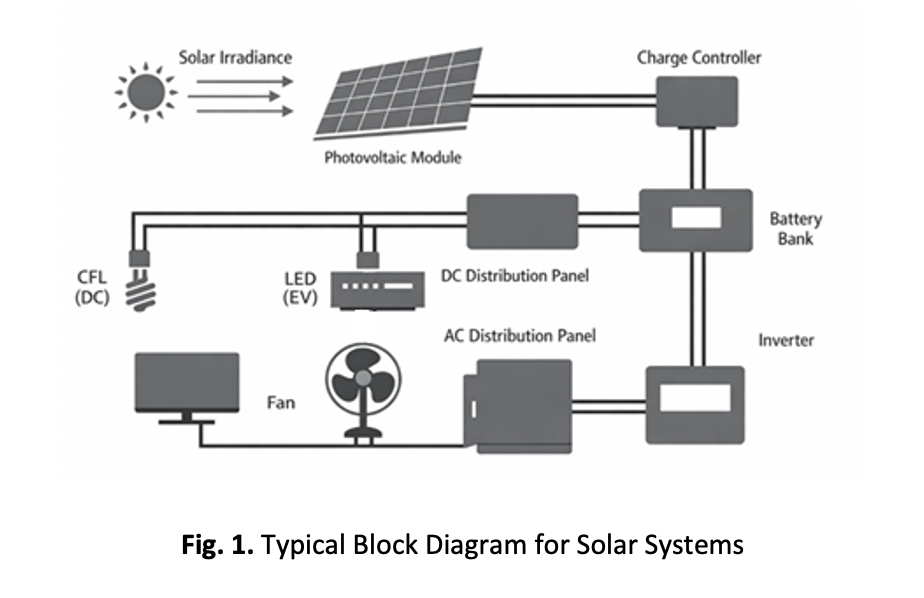
Education in renewable energy plays an important role in meeting global sustainability goals, including the proliferation of solar power technologies. Nevertheless, insufficient laboratory facilities and practical teaching aids prevent students from mastering the solar energy system. In this work, we develop and evaluate a low-cost solar power educational kit for secondary school and higher education. The kit facilitates hands-on understanding of the principles of solar photovoltaics (PV), series and parallel PV circuits, charge control systems and battery storage systems for an introduction to basic DC-to-AC inverter operation. Under simulated solar illumination from halogen lamps, we measured current–voltage (I–V) characteristics, power output behaviour and system response to changing illumination. Results indicated that towards theoretical prediction, the series PV arrangements have greater voltage and power outputs than single or even parallel configurations. The developed learning tool is shown to be successful in delivering basic solar knowledge with an affordable, safe and user-friendly format for STEM education. This method reinforces the students’ practical exposure to renewables systems and will assist in sustainable energy-type teaching schemes.

Author Biography

Norliana Yusof, Faculty of Innovative Design and Technology, Universiti Sultan Zainal Abidin, 21300 Kampus Gong Badak, Terengganu, Malaysia

norliana@unisza.edu.my

Downloads

Published

2026-05-10

Issue

Section

Articles