
Temperature and Time Effects on Copper Electroplating Performance on Cu-Zn Alloys: Thickness, Conductivity and Corrosion Analysis

Authors

  • Nur Syazana Rashidi Department of of Mechanical Engineering, School of Engineering and Computing, MILA University, MIU Boulevard, Nilai, Negeri Sembilan, 71800, Malaysia

Keywords:

Copper Electroplating; Cu-Zn Alloys; ASTM B117; Corrosion analysis

Abstract

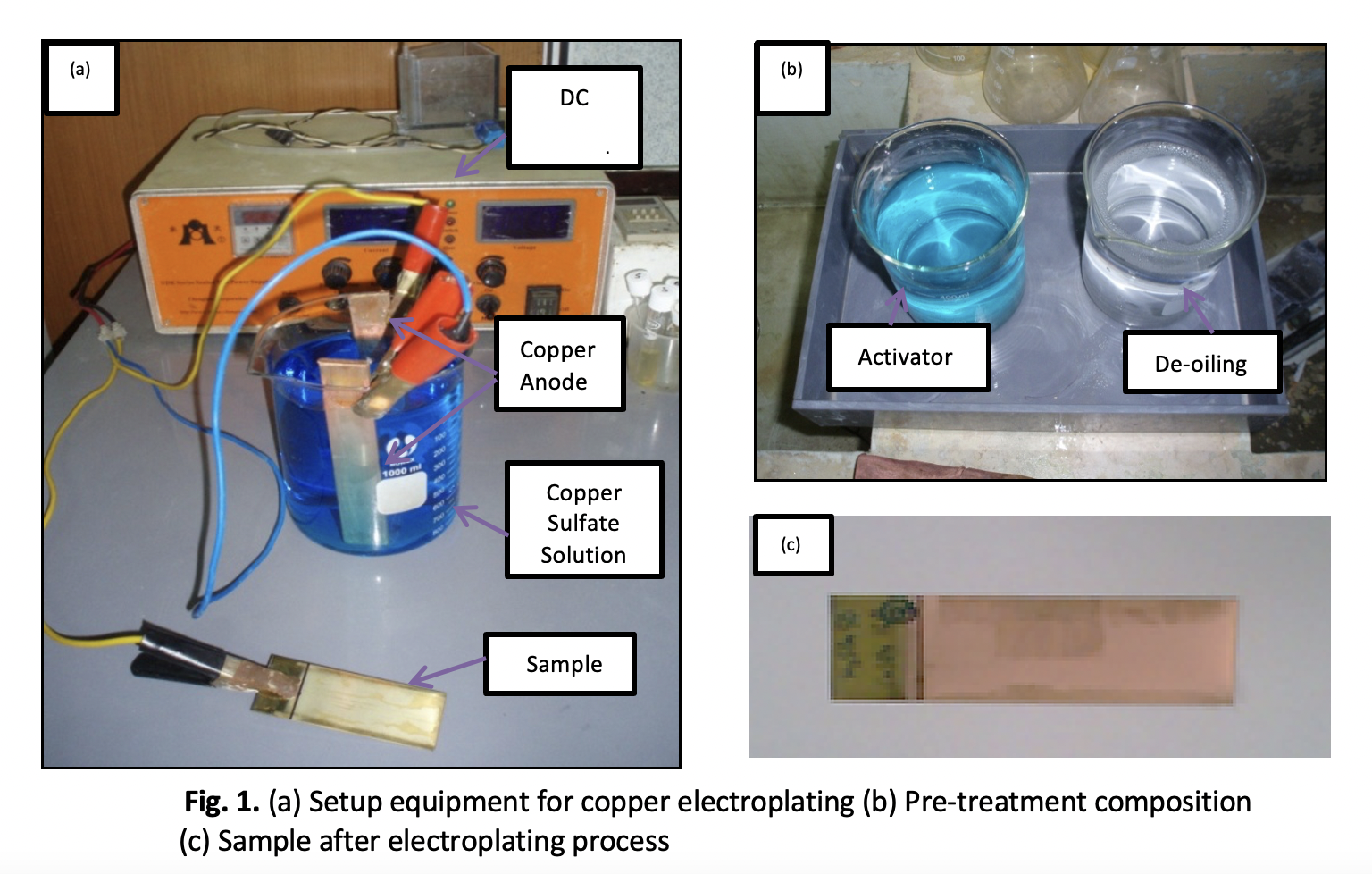
In this work, the effects of bath temperature and plating duration on copper (Cu) electrodeposition onto brass (Cu-Zn) substrates from an acidic copper sulfate electrolyte were studied systematically in terms of buildup thickness as well as the electrical conductivity and  corrosion resistance by means of depth profiling to identify quantitative processing-property relationships for optimization purposes in industrial settings. Copper electroplating at three temperature levels (25°C, 35°C, 45°C) and three plating times (2, 4, 6 minutes) was conducted using constant electrolyte composition (160 g/L CuSO.5H₂O ₄, 70 g/L H₂SO₄) and applied current (1.5 A), allowing for systematic separation of temperature and time effects. Validation tests showed temperature greater than approximately 35°C were also associated with slightly higher susceptibility to corrosion, as indicated by an increase in the rate of corrosion penetration from salt spray exposure test (ASTM B117) after 72-hour period at temperatures between 25-35°C (4.157 mm/yr), versus 45°C (5.820 mm/yr). In addition, the longer 6-minute plating time led to excellent electrical conductivity with a resistivity of 4.082 mΩ/cm, indicating excellent electronic transport properties for electrical applications, while deposition efficiency decreased with extended plating times due to the onset of mass transport limitations in static bath conditions. The intermediate temperature of 35°C was identified as the optimal operating point, exhibiting suitable performance across various properties, obtaining considerable thickness while maintaining excellent corrosion resistance and conductivity at moderate energy consumption. The comprehensive dataset offers definitive process optimization recommendations, such as maximum productivity at 45°C, ideal corrosion resistance at 25–35°C, a 6-minute duration for optimal conductivity, and a combination of 35°C for 4 minutes for maximum versatility and general-purpose applications that provide balanced overall performance.

Author Biography

Nur Syazana Rashidi, Department of of Mechanical Engineering, School of Engineering and Computing, MILA University, MIU Boulevard, Nilai, Negeri Sembilan, 71800, Malaysia

syazana.rashidi@mila.edu.my

Downloads

Published

2026-06-08

Issue

Section

Articles