
Enzyme Assays on Antidiabetic Properties of Tebu Gajah (Albizia myriophylla) Dried Jelly

Authors

  • Siti Roshayu Hassan Bioproduct and Bioprocessing Technology Research Group, Faculty of Bioengineering and Technology, Universiti Malaysia Kelantan, Jeli Campus, 17600 Jeli, Kelantan, Malaysia
  • Allia Roslan Faculty of Bioengineering and Technology, Universiti Malaysia Kelantan, Jeli Campus, 17600, Jeli, Kelantan, Malaysia

Keywords:

Tebu Gajah, α-amylase, enzyme inhibition, dried jelly, antidiabetics

Abstract

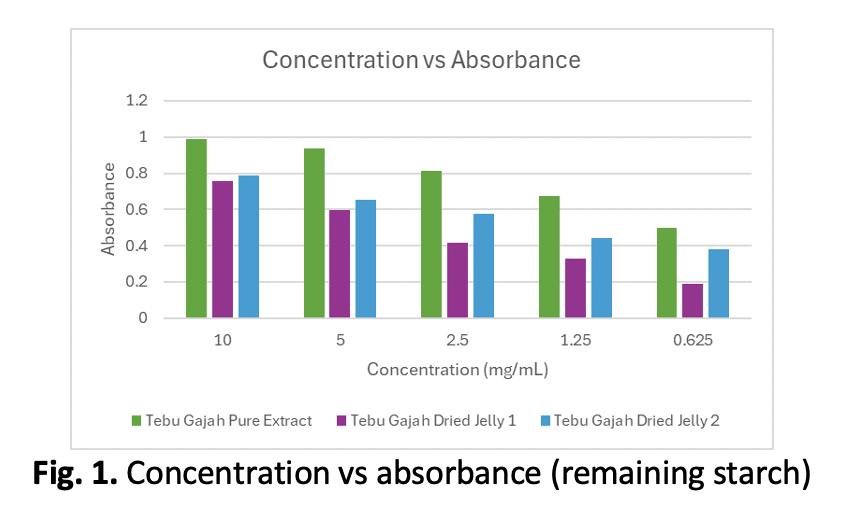
Tebu Gajah is a plant with high potential as a traditional medicine in Southeast Asia and is believed to have some antidiabetic properties due to a high phytochemical composition, especially phenols and flavonoids. The objective of this research paper was to identify and determine the α-amylase inhibitory property of the Tebu Gajah dried jelly extract in different concentrations and then compare the α-amylase inhibitory property of the extract with the α-amylase inhibitory property of the pure plant extract. The inhibition strength will be further determined by comparing the IC50. Tebu Gajah pure extract and dried jelly were crudely extracted with 70% ethanol. These extracts were further treated with 10, 5, 2.5, 1.25, and 0.625 mg/mL. α-Amylase inhibition was performed using the iodine-starch colorimetric system where the absorbance value was measured at 620 nm. The % inhibition, strength of inhibition (IC50), and % inhibition correlation were determined. The results showed that in all Tebu Gajah samples, inhibitory activity was dose-dependent. Pure extract exhibited the best inhibitory value of 72.09 % at 10mg/mL, then dried jelly extract 2 and 1 with values 56.83 % and 54.29 %, respectively. Even with reduced inhibitory potency due to the presence of the transformation process of dried jelly, it was observed that both forms of the jelly are efficient inhibitors of the enzymes. The level of the extracts and percentage inhibitions showed a positive correlation, which was more pronounced in the dried extracts. Consequently, there was a conclusion drawn to imply that the dried form of Tebu Gajah jelly has the ability to inhibit a-amylase in a functional food in regulating starch and glucose. However, more research would be needed in phytochemicals and in vivo studies concerning its use in antidiabetics.

Downloads

Published

2026-06-08

Issue

Section

Articles