
Investigation of Human Robot Collaboration Safety Based on Speed and Separating Monitoring

Authors

  • Mohamed Hosni Mohamed Ali Department of Mechanical Engineering, Arab Academy for Science, Technology and Maritime Transport, Sheraton, Cairo, Egypt
  • Moustafa Rostom Atia Department of Mechanical Engineering, Arab Academy for Science, Technology and Maritime Transport, Sheraton, Cairo, Egypt
  • Moustafa Ahmed Fouz Department of Mechanical Engineering, Arab Academy for Science, Technology and Maritime Transport, Sheraton, Cairo, Egypt

Keywords:

Speed and separating monitoring, machine learning, artificial intelligence, machine vision, serial robotic arm

Abstract

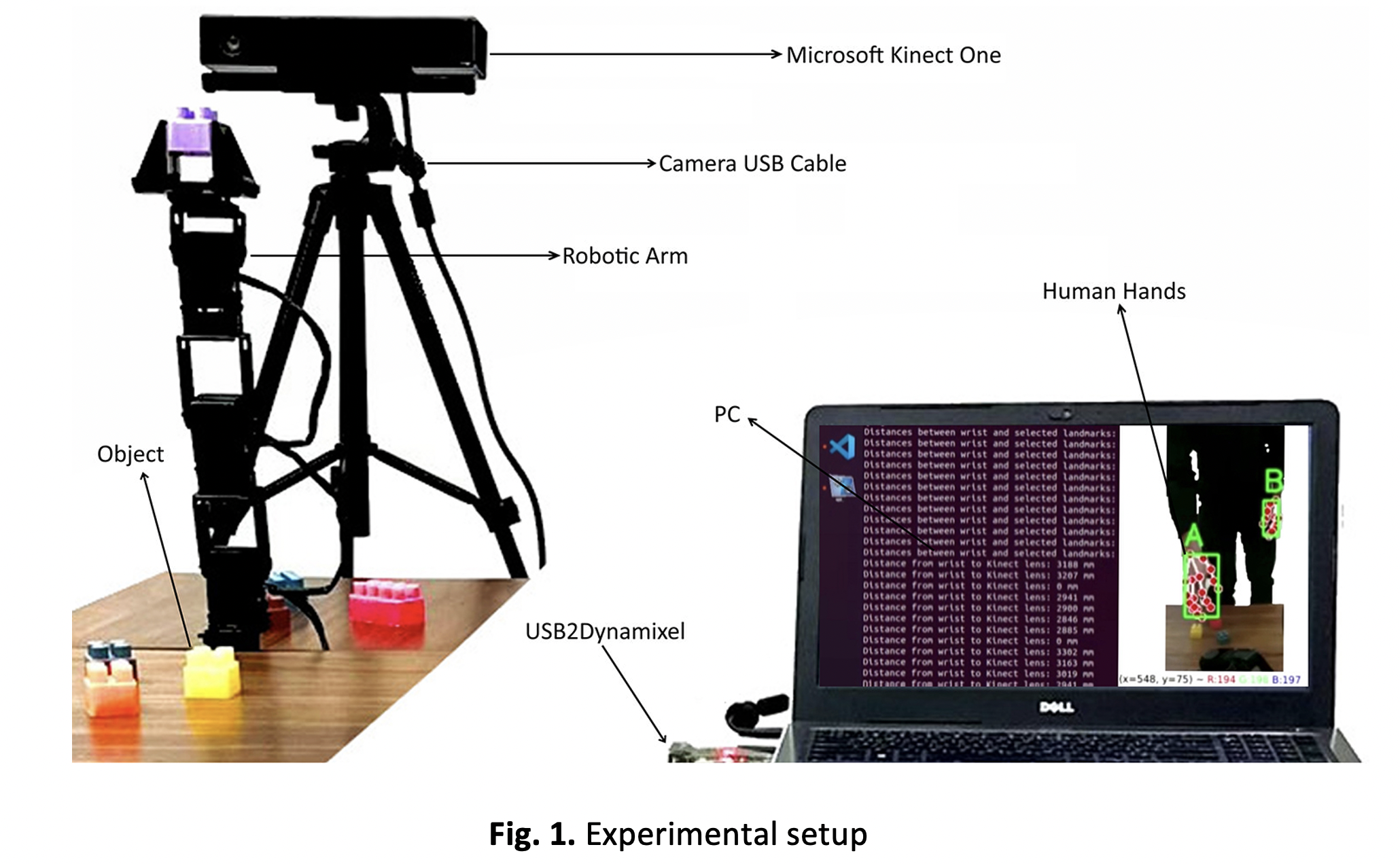
The increasing focus on robotics safety underscores the importance of establishing rigorous standards to protect human operators. ISO/TS 15066 is a pivotal standard that reflects this concern, providing guidelines for human robot collaboration (HRC). This paper focusing on one out of four main techniques in safety standard, which is speed and separation monitoring. The novelty lies in integration of Machine Learning (ML), Artificial Intelligence (AI) and Robot Operating System (ROS) to enhance the decision accuracy. The test rig involves a 4-degree of freedom (DOF) serial robotic arm and Microsoft Kinect One adept at recognizing gesture signs and tracking hand movements. Moreover, the system ensures safety by adjusting the robot speed dynamically, even coming to stop if necessary. The result shows improving in decision. This demonstrates significant contribution to advancing safety standards in robotics.

Author Biography

Mohamed Hosni Mohamed Ali, Department of Mechanical Engineering, Arab Academy for Science, Technology and Maritime Transport, Sheraton, Cairo, Egypt

m-hosni@hotmail.com

Downloads

Published

2026-06-08

Issue

Section

Articles