
Effect of Air Flow Rate and Temperature on Ash Content, Volatile Ingredients, and Calories through Partial Oxidation Method in Converting Palm Kernel Shells into Adsorbent

Authors

  • Siti Hamidah Mohd-Setapar Malaysia-Japan International Institute of Technology (MJIIT), Universiti Teknologi Malaysia, Jalan Sultan Yahya Petra, 54100 UTM Kuala Lumpur, Malaysia
  • Firman Department of Chemical Engineering, Politeknik Negeri Samarinda, Jalan Dr. Cipto Mangunkusumo, Kampus Gunung Lipan Samarinda, 75131, Kalimantan Timur Province, Indonesia
  • Muh. Irwan Department of Chemical Engineering, Politeknik Negeri Samarinda, Jalan Dr. Cipto Mangunkusumo, Kampus Gunung Lipan Samarinda, 75131, Kalimantan Timur Province, Indonesia
  • Sitti Sahraeni Department of Chemical Engineering, Politeknik Negeri Samarinda, Jalan Dr. Cipto Mangunkusumo, Kampus Gunung Lipan Samarinda, 75131, Kalimantan Timur Province, Indonesia

Keywords:

Air flow rate, activated charcoal, ash content, calories, volatile matter, palm kernel shells, temperature

Abstract

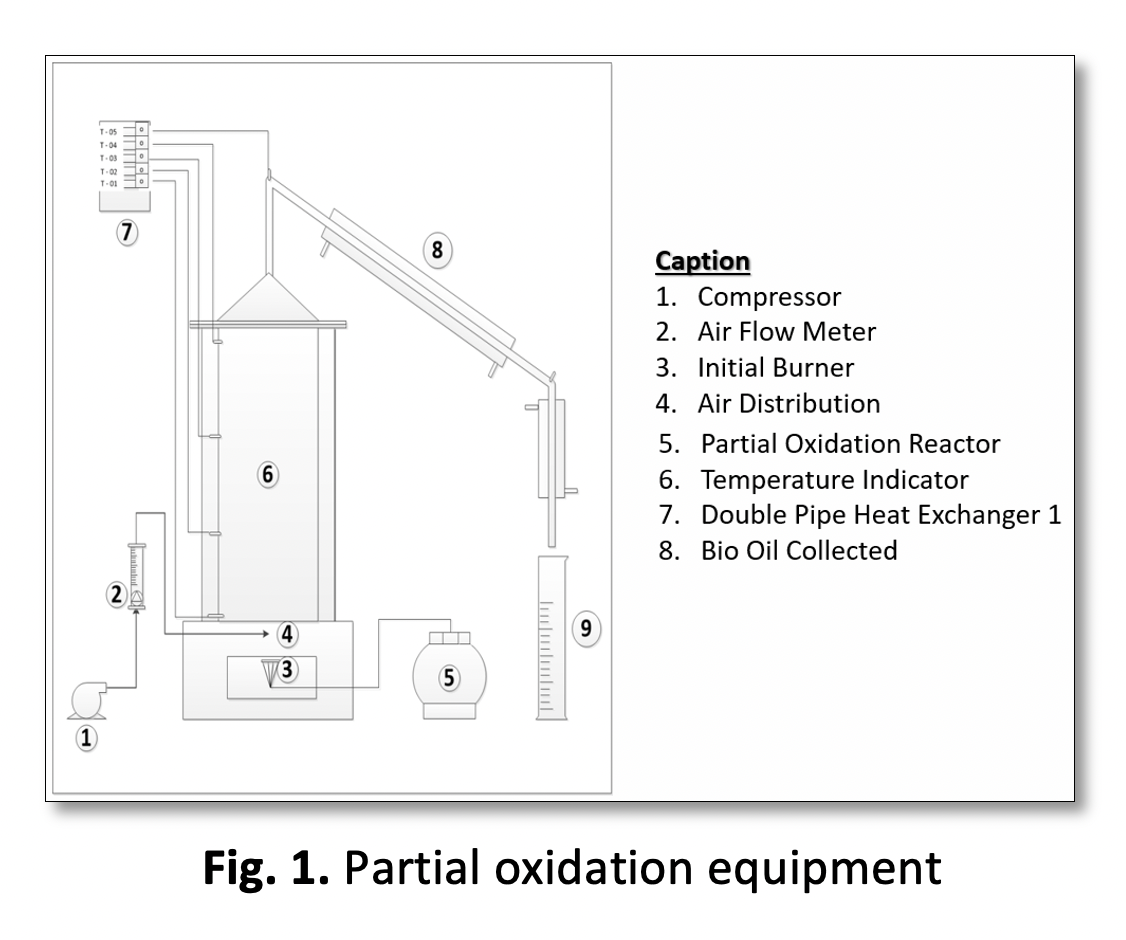
One of the biggest commodities in Indonesia is palm oil. Palm oil production in Indonesia continues to increase from year to year, this of course has an impact on increasing Palm Shell (PKSh) production. It should be noted that PKSh is a by-product of palm oil processing in the form of shells which is quite large in quantity, that is, every ton of palm oil produces 65 kg of PKSh. Palm oil shells contain 26.6% cellulose and 27.7% hemicellulose which is good for making activated charcoal. Basically, PKSh has economic value in the palm oil mill itself because it is used as fuel in boilers, but in large quantities and has the potential to be used as active carbon. Activated charcoal is very useful for gas and liquid-based purification technology, where the activated charcoal will function as an adsorbent medium and can also be used in waste processing.  Therefore, this research will focus on the activation method, in this case, the activation method is carried out using the partial oxidation technique, namely a pyrolysis process carried out at air flow speeds of 20, 25, 30, 35, and 40 L/minute for 5 hours. This research aims to determine the effect of airflow rate and activated charcoal yield on the values ​​of Ash Content, Volatile Materials, and Fixed Carbon by referring to SNI standard No. 06-3730-1995.  The best results were shown at an airflow rate of 35 L/minute with a product yield of 20%, ash content of 7.51%, volatile matter content of 8.73%, and fixed carbon of 77.94%. These results have met SNI 06-3703-1995 standards.

Author Biography

Siti Hamidah Mohd-Setapar, Malaysia-Japan International Institute of Technology (MJIIT), Universiti Teknologi Malaysia, Jalan Sultan Yahya Petra, 54100 UTM Kuala Lumpur, Malaysia

Siti-h@utm.my

Downloads

Published

2026-06-08

Issue

Section

Articles