
Developing Blast Prediction Model for Composition 4 (C4) Explosive using Support Vector Machine (SVM)

Authors

  • Prakash Nagappan Army Logistic Command, Ministry of Defence, Malaysia, Faculty of Engineering, National Defence University of Malaysia (UPNM), Malaysia
  • Farah Nadiah Abdul Rahim Army Logistic Command, Ministry of Defence, Malaysia, Faculty of Engineering, National Defence University of Malaysia (UPNM), Malaysia
  • Fakroul Ridzuan Hashim Army Logistic Command, Ministry of Defence, Malaysia, Faculty of Engineering, National Defence University of Malaysia (UPNM), Malaysia
  • Mohammed Alias Yusof Army Logistic Command, Ministry of Defence, Malaysia, Faculty of Engineering, National Defence University of Malaysia (UPNM), Malaysia

Keywords:

Support Vector Machine (SVM) regression, composition 4 (C4), blast prediction model, k-fold cross validation, radial base function

Abstract

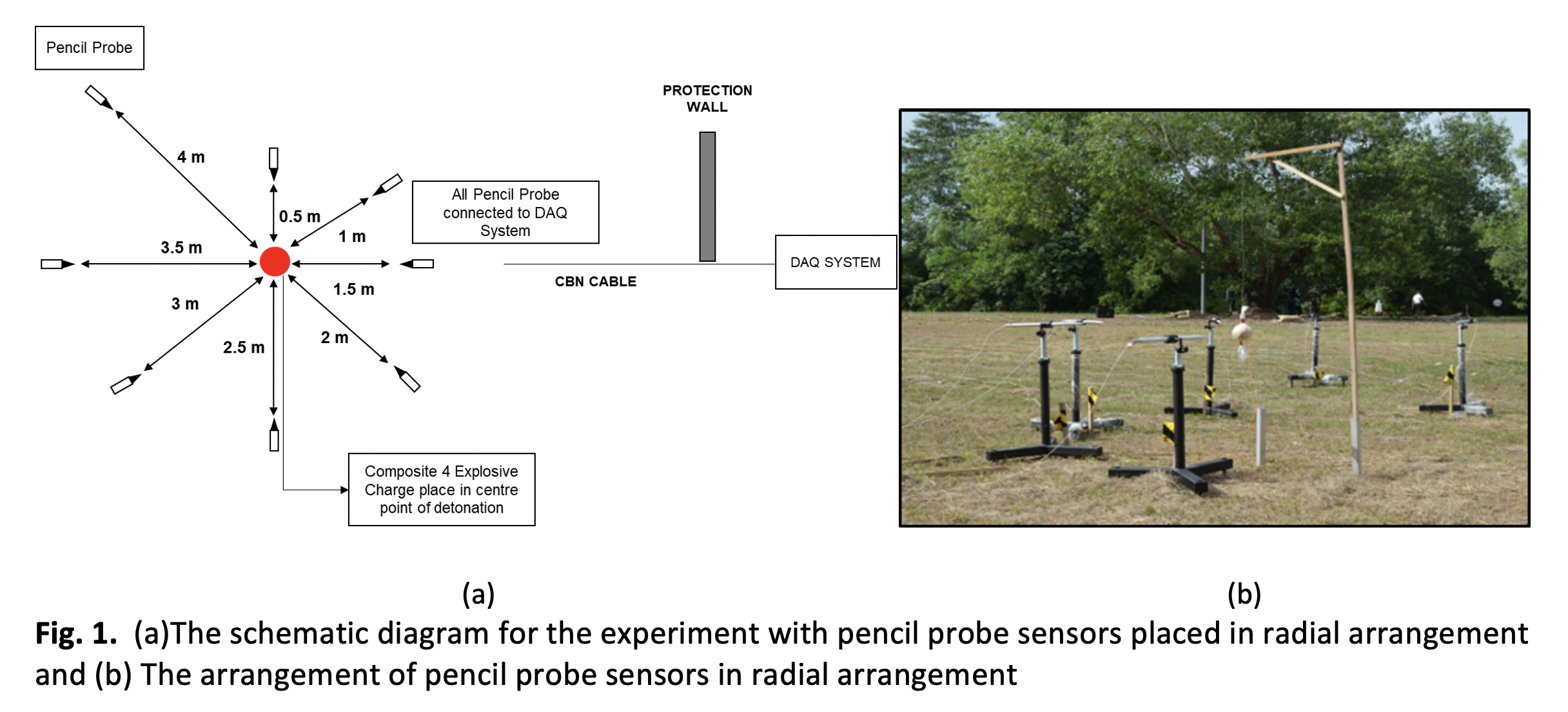
The Kingery-Bulmash equation has been widely adopted as an explosion prediction model comprising of empirical data for detonation parameters. Theoretically, support vector machine (SVM) is one of the machine learning components that fit small datasets and can generate models with higher accuracy. This study was conducted to develop an explosive prediction model for Composition 4 (C4) using the SVM regression method with explosives weighing in the range from 0.1 to 1.0 kg in burst surface explosion conditions. The experiment was conducted to identify four parameters, namely peak pressure, arrival time, inclined pressure, and reflection pressure, at distances of 0.5 to 5.0 m. The dataset gain was used to develop the prediction model using linear, radial base and polynomial kernel functions. The accuracy for each model was determined using mean square error (MSE), root mean square error (RMSE) and mean absolute error (MAE). The optimisation was conducted using search grid analysis to identify the best configuration for penalty factor (C), epsilon, (ε) and gamma (γ). K-fold cross-validation was used to validate the prediction accuracy. The research focuses on the prediction of blasts, and the model shows significant results with 89% accuracy. The radial basis function (RBF) kernel has better fitting for the dataset and produces a higher accuracy prediction algorithm than linear and polynomial kernel functions.

Author Biography

Prakash Nagappan, Army Logistic Command, Ministry of Defence, Malaysia, Faculty of Engineering, National Defence University of Malaysia (UPNM), Malaysia

xzrann@gmail.com

Downloads

Published

2026-06-08

Issue

Section

Articles