
Optimization of Pectin Production Parameters from Pineapple Waste

Authors

  • Dayang Norulfairuz Abang Zaidel Department of Chemical and Environmental Engineering, Malaysia-Japan International Institute of Technology, Universiti Teknologi Malaysia, 54100 Kuala Lumpur, Malaysia
  • Norfazilah Muhamad Department of Chemical and Environmental Engineering, Malaysia-Japan International Institute of Technology, Universiti Teknologi Malaysia, 54100 Kuala Lumpur, Malaysia
  • Nur Eleena Sadikon Josa Pina Trading Sdn Bhd, Sunway Iskandar, Persiaran Medini 3, Bandar Sunway Iskandar Puteri, 79250 Iskandar Puteri Johor, Malaysia
  • Roshanida A Rahman Faculty of Chemical and Energy Engineering, Universiti Teknologi Malaysia, 81310 Skudai, Johor Darul Ta’zim, Malaysia
  • Siti Nor Azlina Abd Rashid Innovation Centre in Agritechnology for Advanced Bioprocessing, Universiti Teknologi Malaysia Pagoh Campus, Pagoh, Johor, Malaysia
  • Zuhaili Idham Institute of Bioproduct Development, Universiti Teknologi Malaysia, 81310, Skudai, Johor Darul Ta’zim, Malaysia
  • Noorazwani Zainol Institute of Bioproduct Development, Universiti Teknologi Malaysia, 81310, Skudai, Johor Darul Ta’zim, Malaysia
  • Effaliza Misran Institute of Bioproduct Development, Universiti Teknologi Malaysia, 81310, Skudai, Johor Darul Ta’zim, Malaysia
  • Low Kit Hung Faculty of Chemical and Energy Engineering, Universiti Teknologi Malaysia, 81310 Skudai, Johor Darul Ta’zim, Malaysia
  • Harisun Yaakob Faculty of Chemical and Energy Engineering, Universiti Teknologi Malaysia, 81310 Skudai, Johor Darul Ta’zim, Malaysia

Keywords:

Optimisation, Vegan and Halal Friendly, Microwave Assisted Extraction, Pineapple waste, Edible Pectin

Abstract

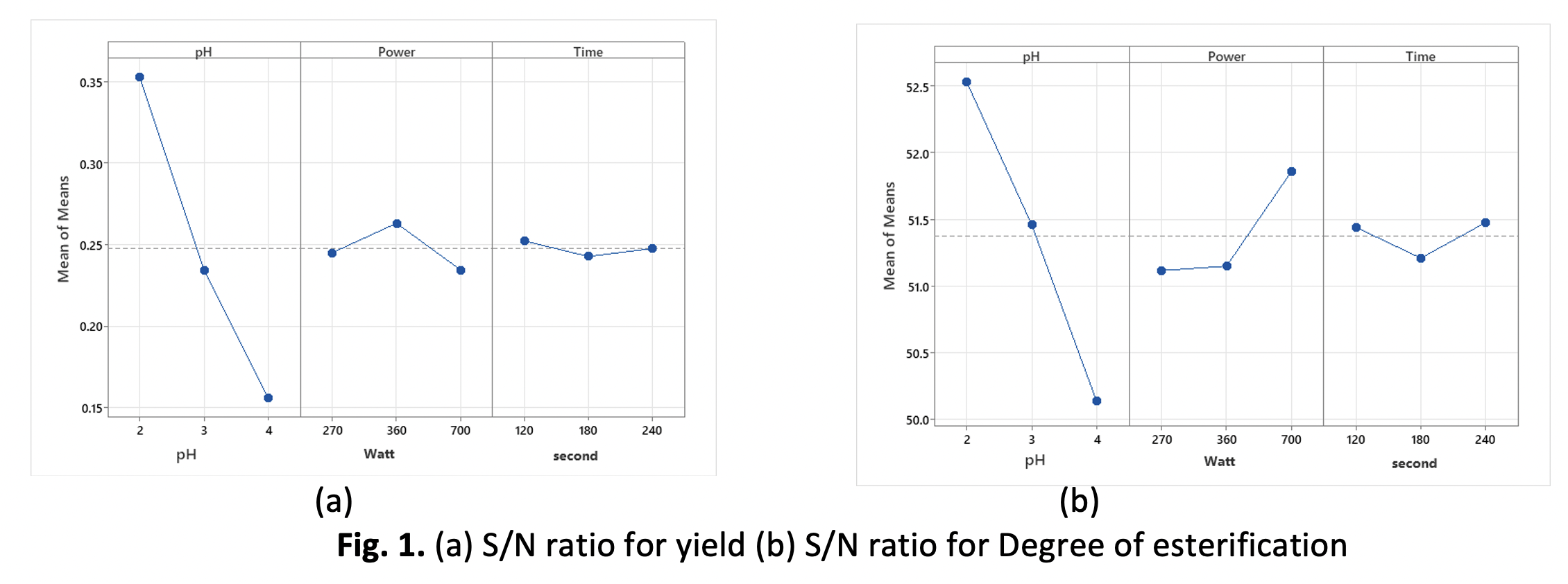
The objective of this study was to optimise the extraction parameters for enhancing the yield of pectin production from pineapple waste. The production of pectin from the pineapple waste was optimised with parameters such as time(120-240s), microwave power (270 W, 360 W, and 700 W), and pH 2-4 to achieve the optimal pectin yield.  The Minitab Taguchi approach was used to optimise the parameter to get a high yield of pectin. Additionally, FTIR analysis was utilised to evaluate the quality of the product. The results are a significant yield of 3.7 g and a degree of esterification of 52.4% from 100 g of pineapple waste. These results may be achieved by using the ideal parameters of pH 2, 360 W, and 180 s. To summarise, this study allows for the production of large amounts of high-grade pectin from pineapple waste. The extracted pectin can be utilised in culinary and medical uses as a renewable and eco-friendly component.

Author Biography

Dayang Norulfairuz Abang Zaidel, Department of Chemical and Environmental Engineering, Malaysia-Japan International Institute of Technology, Universiti Teknologi Malaysia, 54100 Kuala Lumpur, Malaysia

dnorulfairuz@utm.my

Downloads

Published

2026-06-08

Issue

Section

Articles