
Experimental Investigation of Bio-Oil Droplet Impact on Liquid Pools Across Wide Temperature and Weber Number Ranges

Authors

  • Khairil Faizi Mustafa School of Mechanical Engineering, Tuanku Syed Sirajuddin Engineering Campus, 14300 Nibong Tebal, Penang, Malaysia
  • Omer Khalid Shihab Ertobah School of Mechanical Engineering, Tuanku Syed Sirajuddin Engineering Campus, 14300 Nibong Tebal, Penang, Malaysia
  • Khaled Ali Mohammad Al-attab School of Mechanical Engineering, Tuanku Syed Sirajuddin Engineering Campus, 14300 Nibong Tebal, Penang, Malaysia

Keywords:

Droplet impact, bio-oil, liquid pool surface, Weber number, high-speed imaging, vapour explosion

Abstract

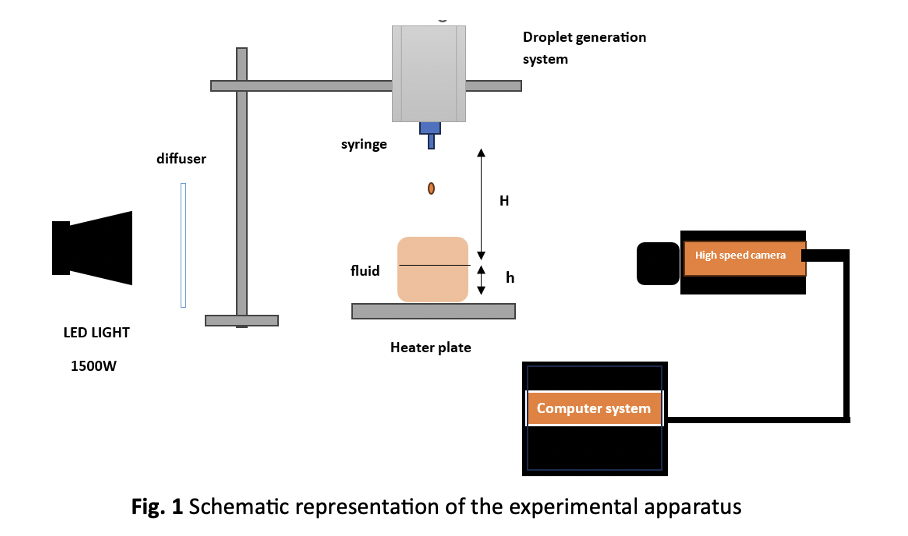
Droplet impact on liquid pool surfaces is important in spray cooling, thermal management, and fuel-related applications. However, the combined effects of temperature, Weber number, and liquid configuration on bio-oil droplet impact dynamics remain insufficiently understood, particularly in relation to splashing, jet formation, and vapour explosion behaviour. This study investigates single-droplet impacts on liquid pool surfaces under controlled thermal and dynamic conditions for water-to-water, water-to-oil, and oil-to-water configurations. Distilled water and selected bio-oils, including olive oil, peanut oil, sunflower oil, and a waste-oil/olive-oil blend, were tested over a temperature range from room temperature to 290 °C and at Weber numbers between 172 and 1011. High-speed imaging was employed to capture the transient interfacial dynamics. The results show that Weber number and temperature are dominant parameters governing droplet deformation, jet formation, and instability development. As impact intensity increases, water-to-oil impacts produce greater spreading, crown formation, and jet development, with maximum jet height reaching Hj/D₀ ≈ 9.13 and crown height up to 12.3D₀. In contrast, oil-to-water impacts remain stable and splash-free across all tested conditions, highlighting the stabilizing influence of viscosity and liquid configuration. At 290 °C, vapour explosion events were observed, indicating intensified thermofluid interactions and rapid vapour generation at the liquid interface. These findings provide a unified physical understanding of the coupled effects of inertia, temperature, and liquid properties on bio-oil droplet interactions, while offering useful guidance for improving stability, heat transfer control, and safety in high-temperature industrial and renewable-energy systems.

Author Biographies

Khairil Faizi Mustafa, School of Mechanical Engineering, Tuanku Syed Sirajuddin Engineering Campus, 14300 Nibong Tebal, Penang, Malaysia

mekhairil@usm.my

Omer Khalid Shihab Ertobah, School of Mechanical Engineering, Tuanku Syed Sirajuddin Engineering Campus, 14300 Nibong Tebal, Penang, Malaysia

Omaralobaidy728@gmail.com

Khaled Ali Mohammad Al-attab, School of Mechanical Engineering, Tuanku Syed Sirajuddin Engineering Campus, 14300 Nibong Tebal, Penang, Malaysia

khaled@usm.my

Downloads

Published

2026-06-10

Issue

Section

Articles