
Spreading and Splashing Dynamics of Bio-Oil Droplets upon Impaction on Inclined Metal Surfaces

Authors

  • Khairil Faizi Mustafa School of Mechanical Engineering, Tuanku Syed Sirajuddin Engineering Campus, 14300 Nibong Tebal, Penang, Malaysia
  • Omer Khalid Shihab Ertobah School of Mechanical Engineering, Tuanku Syed Sirajuddin Engineering Campus, 14300 Nibong Tebal, Penang, Malaysia
  • Khaled Ali Mohammad Al-attab School of Mechanical Engineering, Tuanku Syed Sirajuddin Engineering Campus, 14300 Nibong Tebal, Penang, Malaysia

Keywords:

Droplet impact, inclined surface, bio-oil, Weber number, surface roughness

Abstract

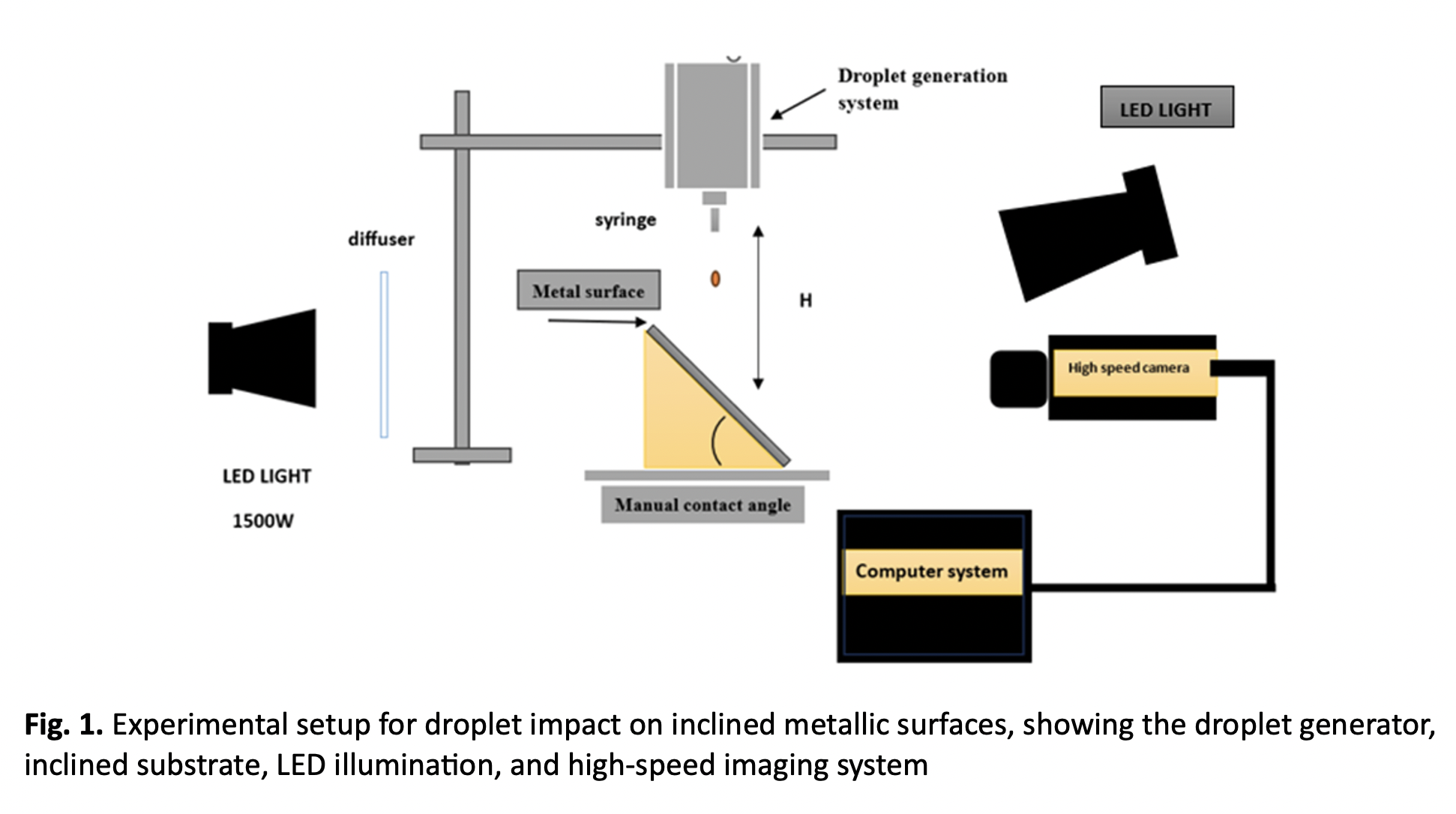
Droplet impact on inclined metallic surfaces is critical in heat transfer, coating, and bio-oil delivery systems; however, existing studies have largely focused on low-viscosity fluids and horizontal surfaces, with limited understanding of high-viscosity bio-oils under inclined and rough surface conditions. This study systematically examines the impact dynamics of droplets composed of olive, peanut, sunflower, and a 50% waste–50% olive oil blend on aluminium, copper, mild steel, and stainless steel at room temperature. Droplets with diameters of 2.6–3.2 mm were released at velocities of 3.96 m/s to 4.54 m/s, corresponding to Weber numbers of 923–1214, onto substrates inclined at 5° to 60° with surface roughness Ra ≈ 0.1 to 2.2 µm. High-speed imaging was employed to capture droplet deformation, spreading, and instability during impact. The results display that increasing inclination disrupts spreading symmetry and promotes downslope elongation, while higher inertia enhances deformation and may induce localized splashing. Surface roughness exhibits a regime-dependent effect, where rougher surfaces facilitate contact-line pinning and suppress spreading, whereas smoother surfaces promote lamella mobility and splashing, particularly for low-viscosity liquids. Moreover, fluid viscosity plays a critical stabilizing role, with bio-oils resisting jetting and fragmentation compared to water. These findings demonstrate the coupled effects of inertia, inclination, surface roughness, and fluid properties on droplet impact dynamics, providing a unified physical understanding and practical guidance for optimizing spray cooling, coating, and fuel deposition processes on inclined metallic surfaces.

Author Biographies

Khairil Faizi Mustafa, School of Mechanical Engineering, Tuanku Syed Sirajuddin Engineering Campus, 14300 Nibong Tebal, Penang, Malaysia

mekhairil@usm.my

Omer Khalid Shihab Ertobah, School of Mechanical Engineering, Tuanku Syed Sirajuddin Engineering Campus, 14300 Nibong Tebal, Penang, Malaysia

Omaralobaidy728@gmail.com

Khaled Ali Mohammad Al-attab, School of Mechanical Engineering, Tuanku Syed Sirajuddin Engineering Campus, 14300 Nibong Tebal, Penang, Malaysia

khaled@usm.my

Downloads

Published

2026-06-10

Issue

Section

Articles