
Green Synthesis of Copper Nanoparticles using Turmeric (Curcuma longa) Mixed with Activated Carbon for Adsorption of Remazol Brilliant Blue R Dye from Wastewater

Authors

  • Muhammad Fitri Rozmi Department of Chemical and Environmental Engineering, Malaysia-Japan International Institute of Technology, Universiti Teknologi Malaysia, 54100, Kuala Lumpur, Malaysia
  • Roshafima Rasit Ali Department of Chemical and Environmental Engineering, Malaysia-Japan International Institute of Technology, Universiti Teknologi Malaysia, 54100, Kuala Lumpur, Malaysia
  • Zhongfang Lei Graduate School of Science and Technology, University of Tsukuba, 1-1-1 Tennodai, Tsukuba, Ibaraki 305-8572, Japan
  • Zatil Izzah Ahmad Tarmizi Department of Chemical and Environmental Engineering, Malaysia-Japan International Institute of Technology, Universiti Teknologi Malaysia, 54100, Kuala Lumpur, Malaysia
  • Eleen Dayana Mohamed Isa Department of Chemical and Environmental Engineering, Malaysia-Japan International Institute of Technology, Universiti Teknologi Malaysia, 54100, Kuala Lumpur, Malaysia
  • Rafiziana Md Kasmani Department of Energy Engineering, Faculty of Chemical and Energy Engineering, Universiti Teknologi Malaysia, 81310, Johor Bahru, Malaysia
  • D.Dahyuna Mohd Yunos Department of Energy Engineering, Faculty of Chemical and Energy Engineering, Universiti Teknologi Malaysia, 81310, Johor Bahru, Malaysia

Keywords:

Copper nanoparticles, dye adsorptio, turmeric, waste water treatment

Abstract

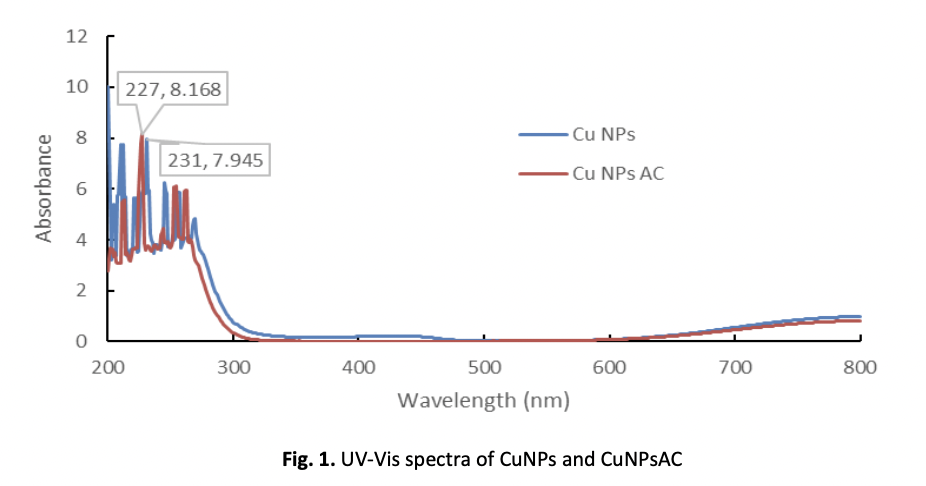
Industrialization has surged alongside economic growth, leading to severe wastewater pollution, particularly from dye disposal, which poses risks to water consumers. This study investigates an innovative method for dye removal from wastewater. Previous research has examined the use of nanoparticles mixed with activated carbon to remove dyes such as methyl orange and reactive red 81. However, no studies have specifically addressed the removal of Remazol Brilliant Blue R (RBBR) dye using a combination of copper nanoparticles and activated carbon. RBBR is frequently found in textile industry wastewater. In this research, activated carbon (AC) derived from banana peels was combined with copper nanoparticles (CuNPs) synthesized using a green synthesis method with Curcuma longa extract. The primary goal was to evaluate the adsorption efficiency of this copper nanoparticle-activated carbon (CuNPsAC) composite for the removal of RBBR dye. The synthesis process involved mixing turmeric extract with NaOH and copper sulfate pentahydrate with AC, followed by combining both mixtures. Samples were characterized using UV-Vis spectrometry, Fourier-transform infrared spectroscopy (FTIR) and Differential Scanning Calorimeter (DSC). The findings revealed that CuNPsAC demonstrated significantly higher adsorption efficiency for RBBR dye (90%) compared to AC alone (65.8%) when using 1g of the adsorbent. Other factors, such as adsorbent mass, contact time, dosage, and solution pH, were optimized, with the best results achieved at 1g CuNPsAC, 160 minutes of contact time, 30 mg adsorbent dosage, and pH 9. This study underscores the effectiveness of the CuNPsAC composite in removing dye pollutants from wastewater, offering a sustainable solution for dye wastewater treatment. The green synthesis method using Curcuma longa and banana peels not only boosts dye removal efficiency but also presents an eco-friendly alternative to traditional approaches. These findings suggest a promising strategy for reducing the environmental impact of textile dye effluents.

Downloads

Published

2026-06-17

Issue

Section

Articles