

MATLAB Implementation of Response Surface Methodology for Structural Damage Identification Using Frequency Response Function Curvature

Authors

  • Nur Raihana Sukri Malaysia-Japan International Institute of Technology, UTM Kuala Lumpur, 54100 Kuala Lumpur, Malaysia
  • Nurulakmar Abu Husain Malaysia-Japan International Institute of Technology, UTM Kuala Lumpur, 54100 Kuala Lumpur, Malaysia
  • Syarifah Zyurina Nordin Malaysia-Japan International Institute of Technology, UTM Kuala Lumpur, 54100 Kuala Lumpur, Malaysia
  • Aminudin Abu Malaysia-Japan International Institute of Technology, UTM Kuala Lumpur, 54100 Kuala Lumpur, Malaysia
  • Annisa Jusuf Faculty of Mechanical and Aerospace Engineering, Institut Teknologi Bandung, 40132 Bandung, Indonesia

Keywords:

Structural damage identification, FRF curvature, response surface methodology, model updating

Abstract

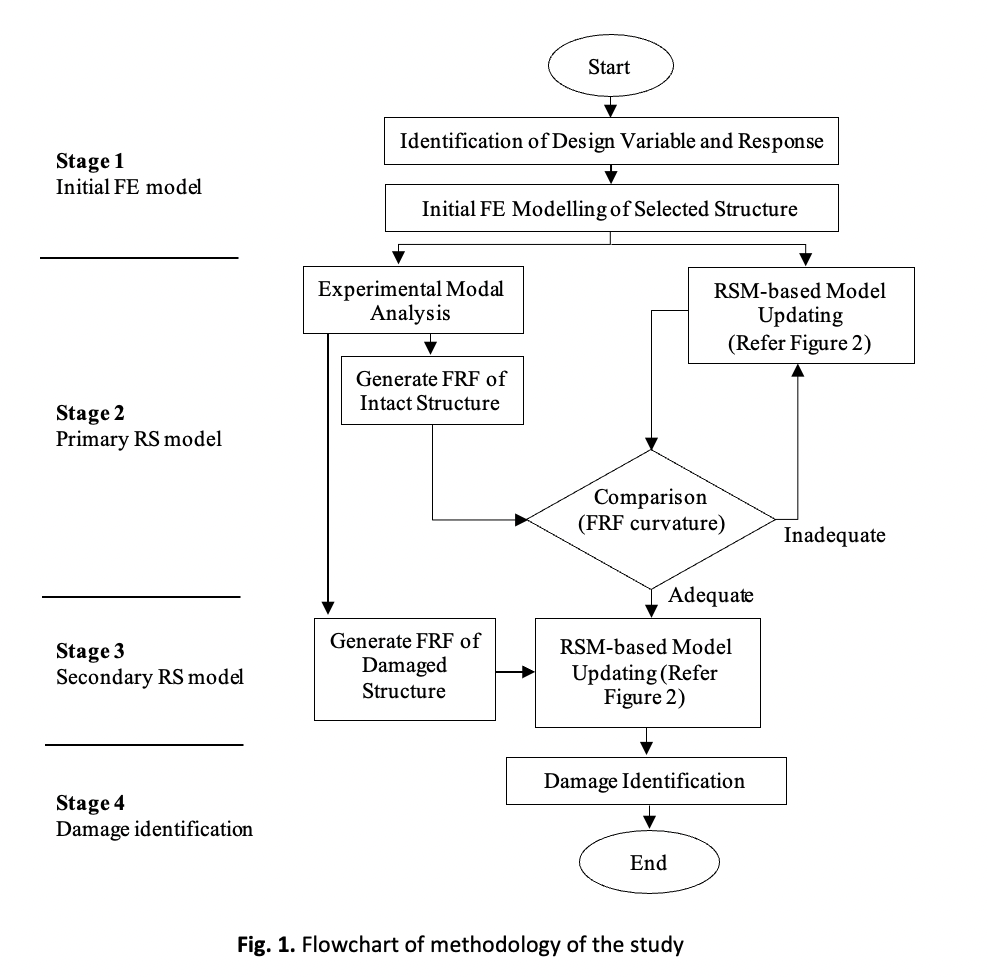
Structural health monitoring and damage identification are critical for maintaining the integrity and safety of engineering structures. Traditional methods often struggle with accurately identifying damage, particularly in complex structures. This study addresses this challenge by developing a MATLAB-based framework that employs Response Surface Methodology (RSM) and Frequency Response Function (FRF) curvature for model updating in structural damage identification. The methodology involves several key stages: initial finite element (FE) model development, DOE to strategically select parameters, computation of FRF curvature to capture structural responses, construction of primary and secondary response surface models, and an iterative model updating process. The simply supported beam model, with its practical and representative nature, serves as the numerical example. The model's accuracy is validated through comparison with established studies, confirming the low percentage errors in natural frequencies. The response surface models exhibit a strong fit and predictive accuracy, as indicated by high R² values. The study successfully achieves its objective, showing that the RSM-based model updating approach, utilizing FRF curvature, can effectively identify structural damage. In conclusion, this study successfully develops and implements an RSM-based framework for structural damage identification using FRF curvature as the response feature. The findings highlight the method's effectiveness and underscore the need for future research to refine algorithms and validate the approach across a broader range of structural systems, including those exhibiting nonlinear behaviour.

Downloads

Published

2026-06-17

Issue

Section

Articles