
Thermomechanical Optimization of Drill Margin Geometry in Drilling of Ti-6Al-4V: A Coupled FEM-RSM Investigation

Authors

  • Taher Sherif Fathi Mohamed Hassan Department of Maritime Technology and Naval Architecture, Faculty of Ocean Engineering Technology, Universiti Malaysia Terengganu, 21030 Kuala Nerus, Terengganu, Malaysia
  • Mohd Faizal Ali Akhbar Department of Maritime Technology and Naval Architecture, Faculty of Ocean Engineering Technology, Universiti Malaysia Terengganu, 21030 Kuala Nerus, Terengganu, Malaysia

Keywords:

Titanium, Drilling, Ti-6Al-4V, Response Surface Methodology

Abstract

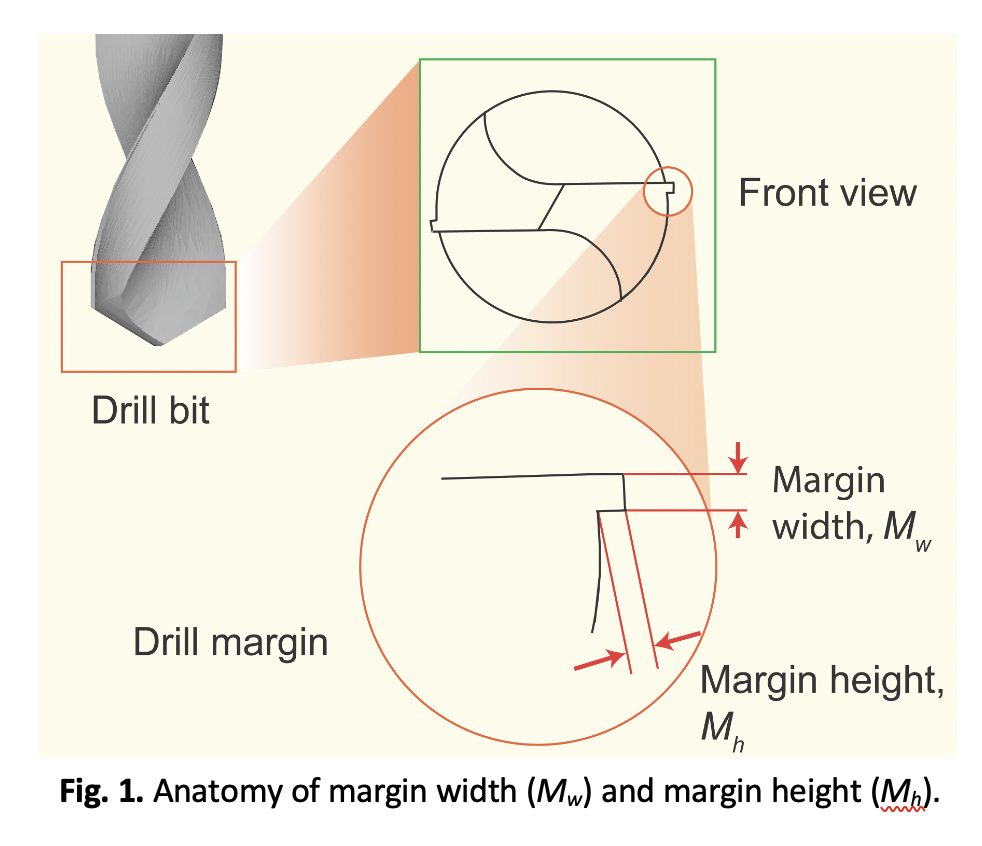
Drilling of titanium alloys generates extreme temperatures, cutting forces, and torque due to their poor thermal conductivity and strong tool–workpiece interaction. These extreme thermomechanical outputs could shorten drill span, reduce hole quality, and increase costs. The drill margin dimensions control frictional contact between the tool and the hole wall. However, the influence of drill margin on thermo-mechanical responses has been scarcely investigated in titanium drilling. In this study, a thermomechanical finite element model (FEM) was developed to analyze the effects of drill margin width (Mw) and margin height (Mh) on drilling temperature, thrust force, and torque. A face-centered central composite design was employed to evaluate the influence of the margin parameters. Response surface methodology (RSM) was used to develop predictive models of temperature, thrust force, and torque. The developed FEM was validated against the experimental results of Chatterjee et al. (2016) at various rotational speeds and feeds in the ranges of 400-600 rev/min and 30-50 mm/min, respectively. The force results produced an average prediction error of 2.5 %, which indicates the simulation model is sufficiently accurate to predict the drilling outputs. The results revealed that both Mw and Mhsignificantly influence drilling performance by varying the frictional contact between the drill margin and the hole wall. Increasing the margin dimensions increases temperature, thrust force, and torque due to intensified rubbing contact. Response surface analysis unveiled a strong interaction between Mw and Mh. The optimal configuration within the investigated design space was identified at Mw = 9% and Mh = 2%. The findings provide useful insights for optimizing drill margin geometry to improve drilling efficiency in titanium alloy (Ti-6Al-4V) machining.

Author Biographies

Taher Sherif Fathi Mohamed Hassan, Department of Maritime Technology and Naval Architecture, Faculty of Ocean Engineering Technology, Universiti Malaysia Terengganu, 21030 Kuala Nerus, Terengganu, Malaysia

downeacy@outlook.com

Mohd Faizal Ali Akhbar, Department of Maritime Technology and Naval Architecture, Faculty of Ocean Engineering Technology, Universiti Malaysia Terengganu, 21030 Kuala Nerus, Terengganu, Malaysia

mfaizalaa@umt.edu.my

Downloads

Published

2026-06-18

Issue

Section

Articles