
Artificial Neural Network–Driven Optimization of Photocatalytic Glycerol Reforming for Sustainable Hydrogen Production

Authors

  • Wei Lin School of Energy and Chemical Engineering, Xiamen University Malaysia, Jalan Sunsuria, Bandar Sunsuria, Selangor Darul Ehsan, 43900 Sepang, Selangor, Malaysia
  • Yixian Li School of Energy and Chemical Engineering, Xiamen University Malaysia, Jalan Sunsuria, Bandar Sunsuria, Selangor Darul Ehsan, 43900 Sepang, Selangor, Malaysia
  • Chien Yong Goh Department of Mathematics, Xiamen University Malaysia, Jalan Sunsuria, Bandar Sunsuria, 43900 Sepang, Selangor, Malaysia
  • Sin Yuan Lai School of Energy and Chemical Engineering, Xiamen University Malaysia, Jalan Sunsuria, Bandar Sunsuria, Selangor Darul Ehsan, 43900 Sepang, Selangor, Malaysia

Keywords:

Process optimization, artificial neural networks, glycerol photoreforming, H2 production, genetic algorithm

Abstract

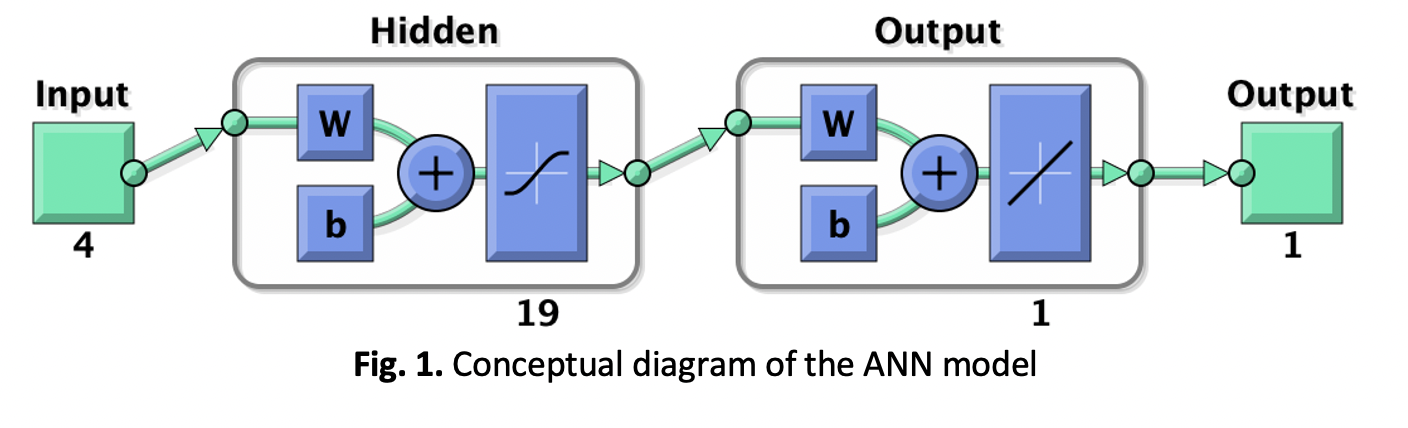
The increasing production of biodiesel in Malaysia has led to a surplus of glycerol by-products, posing environmental and resource management challenges. Photocatalytic reforming of glycerol using TiO2-based photocatalysts presents a promising pathway for sustainable hydrogen generation. However, process optimization is complicated by nonlinear interactions among light intensity, catalyst dosage, glycerol concentration, and reaction duration. This study integrates Artificial Neural Network (ANN), Genetic Algorithm (GA) optimization, and Garson sensitivity analysis to systematically model and optimize hydrogen production under ultraviolet (UV), visible, and UV-visible irradiation. Among the ANN models evaluated, Bayesian Regularization (BR) achieved the highest predictive accuracy under UV light (R2=0.9629), Levenberg-Marquardt (LM) performed best under visible light (R2 = 0.9194), and Scaled Conjugate Gradient (SCG) excelled under UV-visible light (R2 = 0.9245), all with low mean square errors. GA optimization revealed light-dependent optimal conditions, yielding a maximum hydrogen reforming rate of 3.33 × 10⁵ μmol·g⁻¹·h⁻¹ under UV irradiation, while visible and UV–visible conditions produced lower but optimized rates of 3.80 × 10³ and 3.40 × 10³ μmol·g⁻¹·h⁻¹, respectively. Correlation and Garson analyses identified the light power and glycerol concentration dominate under UV irradiation, whereas catalyst loading becomes the main factor under visible and UV-visible light. The results show that specific optimization under different light is essential for maximizing hydrogen production efficiency. The ANN-GA-Garson framework is a data-driven strategy for supporting the waste-to-wealth concept, whereby transforming the biodiesel-derived waste to sustainable hydrogen production.

Downloads

Published

2026-06-22

Issue

Section

Articles