

Interpolating Rainfall Data Trends for Pahang Area using Polynomial Regression

Authors

  • Ismail Md Zani Department of Mathematical Sciences, Faculty of Science, Universiti Teknologi Malaysia, 81310 Skudai, Johor, Malaysia
  • Suzarina Ahmed Sukri Department of Mathematical Sciences, Faculty of Science, Universiti Teknologi Malaysia, 81310 Skudai, Johor, Malaysia
  • Yeak Su Hoe Department of Mathematical Sciences, Faculty of Science, Universiti Teknologi Malaysia, 81310 Skudai, Johor, Malaysia
  • Abdulnasir Isah Department of Mathematical Sciences, Faculty of Science, Universiti Teknologi Malaysia, 81310 Skudai, Johor, Malaysia

Keywords:

Rainfall trend, polynomial regression, rainfall interpolation, Pahang, RMSE

Abstract

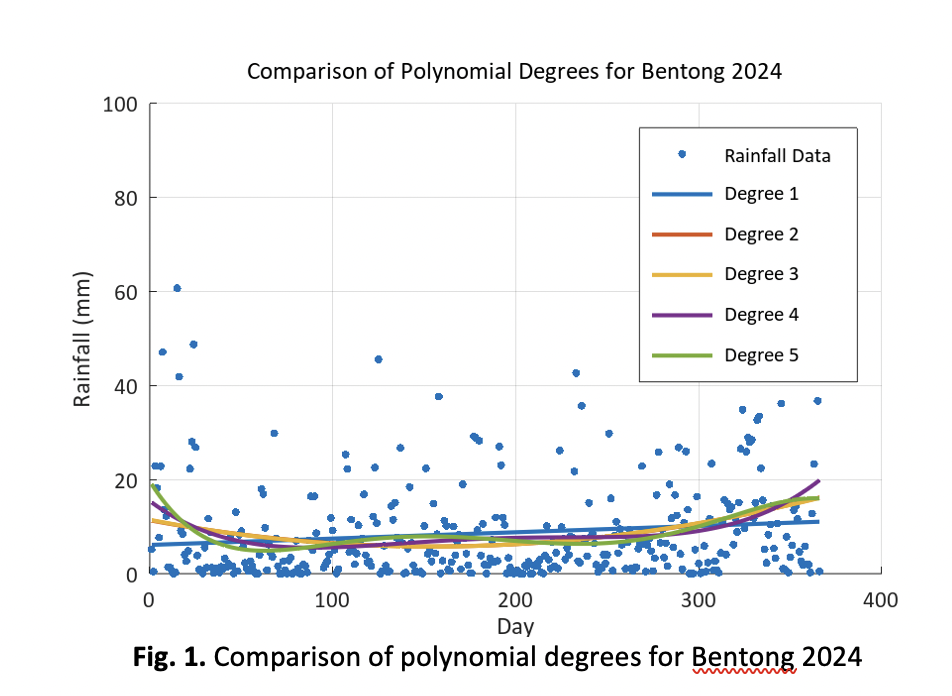
Rainfall data are important to support water resource planning. However, rainfall observations often contain missing values and irregular patterns due to limitations in the system. These limitations can affect the accuracy of rainfall trend analysis. This paper aims to analyse rainfall data trends in the Pahang area using polynomial regression. Daily rainfall data for Bentong and Kuantan were obtained from the NASA POWER Data Access Viewer from 2021 to 2024. Polynomial models from degree one to degree five were compared using root mean square error, and the third-degree polynomial was selected because it provided a suitable balance between fitting accuracy and numerical stability. The polynomial trend of 2024 was compared with the average trend from 2021 to 2023. The results show that rainfall patterns in both stations were non-linear, with rainfall generally decreasing during the early part of the year and increasing towards the later period. The comparison produced root mean square error values of 1.3879 mm for Bentong and 1.9855 mm for Kuantan. The lower value for Bentong indicates that it followed a trend very similar to its historical average, while Kuantan had slightly higher variation. Overall, the findings suggest that polynomial regression is a suitable method for producing a smooth representation of rainfall trends in the Pahang area.

Author Biographies

Suzarina Ahmed Sukri, Department of Mathematical Sciences, Faculty of Science, Universiti Teknologi Malaysia, 81310 Skudai, Johor, Malaysia

suzarina@utm.my

Yeak Su Hoe, Department of Mathematical Sciences, Faculty of Science, Universiti Teknologi Malaysia, 81310 Skudai, Johor, Malaysia

s.h.yeak@utm.my

Abdulnasir Isah, Department of Mathematical Sciences, Faculty of Science, Universiti Teknologi Malaysia, 81310 Skudai, Johor, Malaysia

isahabdulnasir@utm.my

Downloads

Published

2026-06-23

Issue

Section

Articles