Design And Optimization of A Cyclonic Mild Combustion Chamber Fueled by Producer Gas
Keywords:
MILD combustion, Biomass producer gas, Combustion chamber design, Computational fluid dynamics CFD, ANSYS-Fluent, Design of Experiments (DoE), Response optimizerAbstract
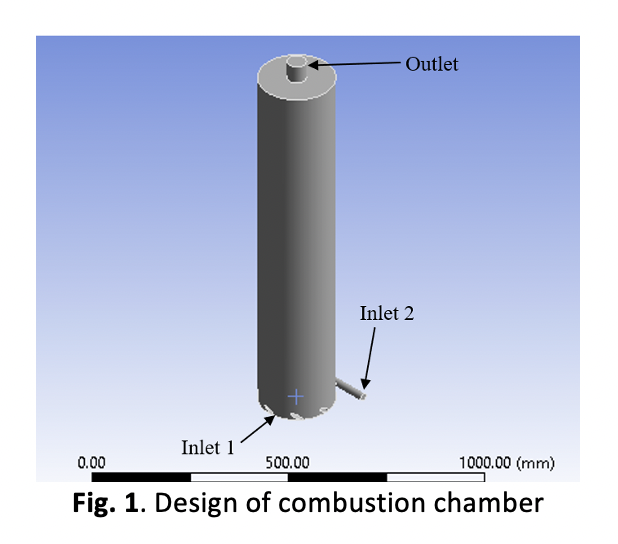
Moderate or Intense Low-Oxygen Dilution (MILD) combustion offers a promising sustainable alternative energy resource, potentially bringing us closer to achieving net-zero emissions. However, limited research on MILD combustion technology means our understanding of its operation and integration into existing systems is still developing. The application of MILD combustion to low-grade biomass producer gas (PG) is particularly underexplored, with only a few studies conducted sporadically. This study aims to design and optimize a compact combustion chamber capable of achieving MILD combustion using low-grade PG, utilizing CFD simulations to assess key performance indicators such as maximum temperature rise (ΔT), Damköhler number (Da), along with (CO) and (NOx) emissions. Two stages of Design of Experiments (DoE) were conducted: the first focused on optimizing the chamber's geometry, and the second on optimizing the swirler's geometry. A total of 18 CFD simulation cases were analysed using a full-factorial DoE to identify the variables that significantly influence MILD combustion and to determine the optimal design. From DoE 1, it was determined that the optimal chamber geometry has a width of 200 mm and a length of 1000 mm, as this configuration increases the chamber volume, thereby enhancing residence time and promoting better mixing of reactants. DoE 2 concluded that the optimal swirler geometry features a swirler angle (ϴ) of 30° and eight blades (N), which generates a stronger vortex field within the chamber, improving fuel-air mixing. The final optimal design achieved CO emissions of 0.74 ppm, NOx emissions of 15.46 ppm, Da of 0.299, and ΔT of 333.5°C.