
Effects of Various Irrigation Water Sources on the Growth of Mustard Green (Brassica chinensis var. parachinensis)

Authors

  • Nor Azlina Hasbullah Department of Agricultural Science, Faculty of Technical and Vocational, Universiti Pendidikan Sultan Idris, 35900 Tanjong Malim, Perak, Malaysia

Keywords:

Tap water, rainwater; distilled water; water characteristics; SAS

Abstract

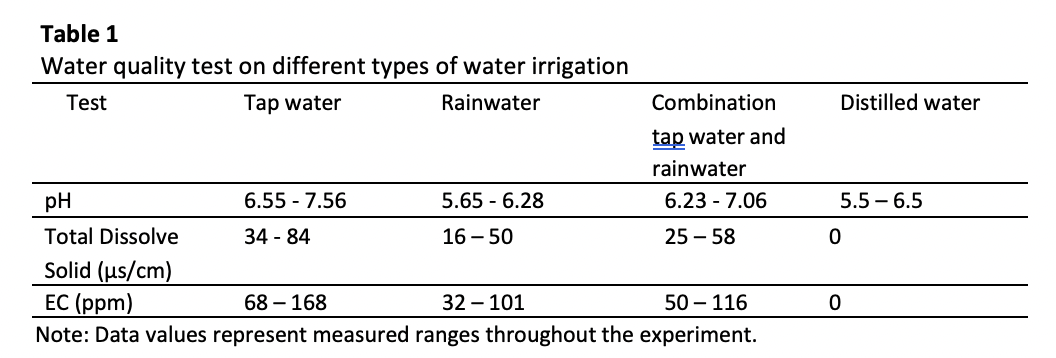
Mustard green (Brassica chinensis var. parachinensis) was the main crop produced after tomato in 2020, with water being a critical factor driving its production volume. Over the last two years, Malaysia has encountered prominent water crises, specifically water supply disruptions and water pollution, which have compromised water sources in terms of both quantity and quality. This study was conducted to evaluate the effects of different irrigation water types on plant performance and to identify the optimal water source for maximizing plant growth and development. The experiment was established at Selayang Baru, Selangor, using a Randomized Complete Block Design (RCBD) featuring 4 treatments and 3 replications. The irrigation treatments evaluated were: tap water (T1), rainwater (T2), a combination of tap water and rainwater (T3), and distilled water (T4). Core growth parameters measured included plant height, number of leaves, leaf surface area, collar diameter, and fresh weight. Data collection was carried out weekly from week 2 post-sowing until the final harvest in week 6. Collected data were subjected to Analysis of Variance (ANOVA), and treatment means were separated using the Least Significant Difference (LSD; P < 0.05) test. The findings revealed no significant differences among the four water types or blocks regarding general plant performance. Readily available water sources demonstrated growth impacts comparable to scarce or highly processed water alternatives. These results indicate that cost-effective tap water can be successfully used without diminishing crop performance, eliminating the need for expensive or hard-to-source water types. Nonetheless, crops irrigated with rainwater achieved a higher mean growth performance, proving safe for irrigation due to acceptable baseline pH and Total Dissolved Solids (TDS) levels. This offers critical economic and ecological insights for gardeners and farmers aiming to implement rainwater harvesting to minimize utility expenses and conserve municipal water resources.

Author Biography

Nor Azlina Hasbullah, Department of Agricultural Science, Faculty of Technical and Vocational, Universiti Pendidikan Sultan Idris, 35900 Tanjong Malim, Perak, Malaysia

Downloads

Published

2026-07-07

Issue

Section

Articles