
A Stakeholder Perspective in Optimising Daylight in Classroom

Authors

  • Amirul Aiman Rio Hendry Faculty of Civil Engineering, Universiti Teknologi Malaysia, Johor Bahru, Malaysia
  • Nur IzieAdiana Abidin Faculty of Civil Engineering, Universiti Teknologi Malaysia, Johor Bahru, Malaysia
  • Suzila Mohd Faculty of Civil Engineering, Universiti Teknologi Malaysia, Johor Bahru, Malaysia

Keywords:

Perspective, Classroom, daylighting, students, earning efficiency, Introduction

Abstract

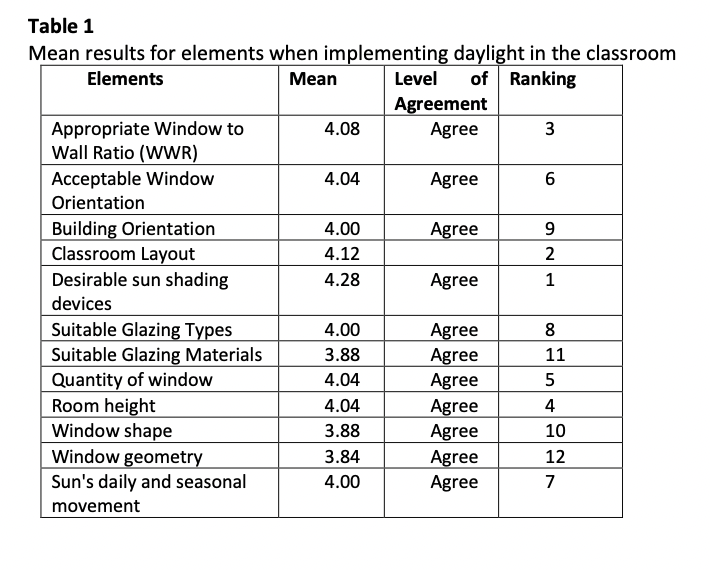
Building daylighting is a desirable energy-saving method compared to the common continuous electrical illumination practice. Natural daylighting is a crucial part for students and educators in performing visual tasks and is very important for their mental health and well-being. Hence, daylight should always be carefully studied since it may offer both visual and thermal comfort, especially in a classroom. This fact explains why there is a constant need to optimize daylight, including its intensity, direction, distribution, and generation of shadow, which have an impact on human physiology and psyche both directly and indirectly These study aims to determine the perspective of daylight implementation in classrooms for student’s learning efficiency. The aim is achieved by identifying the important elements for implementation, investigating challenges faced by occupants, and proposing strategies to improve daylighting in classrooms. A questionnaire survey involving 148 stakeholders consisting of green building certified professionals, architects, engineers, and environmental specialists to gather data on important elements, challenges, and strategies. Statistical analysis was performed using the Statistical Package of Social Science (SPSS) to analyse the collected data. It is found that the most crucial element for daylight implementation is sun shading devices (mean = 4.28), which significantly contributes to visual and thermal comfort. However, the potential major challenge that can be encountered is to provide adequate lighting distribution (mean = 4.13) and potential experience of thermal comfort (mean = 4.04). To address this challenge, the recommended strategy is to use zenithal light pipes to improve lighting distribution and at the same time able to control the heat coming. The findings in this study provide insights to drive the adoption of daylighting implementation and promote sustainable development in campus settings.

Author Biography

Nur IzieAdiana Abidin, Faculty of Civil Engineering, Universiti Teknologi Malaysia, Johor Bahru, Malaysia

izieadiana@utm.my

Downloads

Published

2026-07-18

Issue

Section

Articles