A Novel Generalized Reduced Gradient Optimized Fractional Hausdorff Grey Model for Carbon Dioxide Emission Forecasting
Keywords:
Carbon dioxide emissions, grey forecasting, Fractional Hausdorff accumulation, generalized reduced gradient optimization, CO₂ prediction, environmental forecastingAbstract
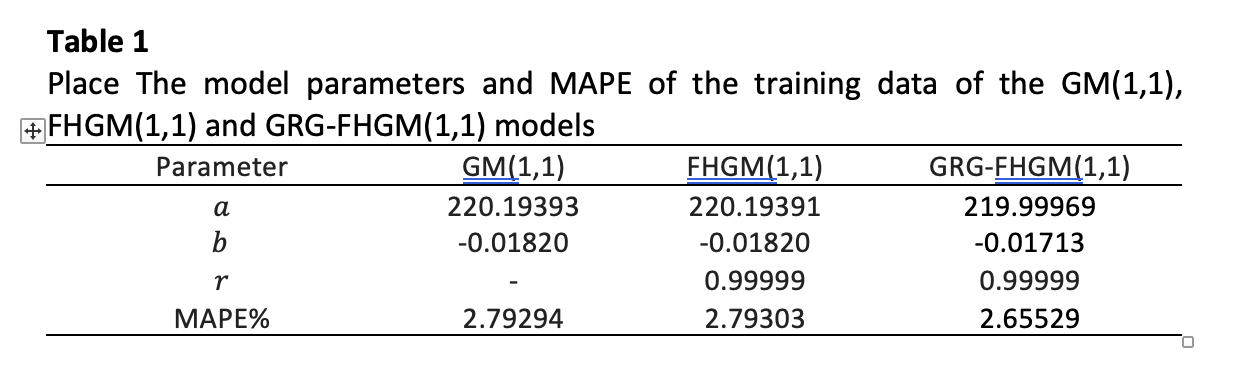
Forecasting CO₂ emissions is a crucial task for environmental management, energy planning and climate change mitigation strategies as it is one of the main drivers of global climate change. The GM(1,1) grey prediction model has been extensively used to predict and solve small sample forecasting problems, but it is usually restricted by the first-order accumulation method and the traditional parameter estimation method, which may not provide the best solution. In view of the above limitations, a Generalized Reduced Gradient Fractional Hausdorff Grey Model (GRG-FHGM(1,1)) is proposed in this paper, which improves on the above shortcomings. In the proposed model, the order of the accumulation is adjusted using the Hausdorff fractional-order accumulation, and the Generalized Reduced Gradient (GRG) nonlinear optimization algorithm is used to optimize the order of the fractional accumulation, the development coefficient and grey input parameter simultaneously. The model's effectiveness was tested with the data of CO₂ emissions from 2010 to 2023 of the International Energy Agency (IEA) for Malaysia. The dataset was divided into training (2010–2019) and testing (2020–2023) periods. GRG-FHGM(1,1)'s forecasting accuracy was tested and matched with four benchmark models: GM(1,1), FHGM(1,1), Linear Regression (LR), and Auto-ARIMA. Experimental results show that the proposed model achieved the lowest testing Mean Absolute Percentage Error (MAPE) of 2.551% and Root Mean Square Error (RMSE) of 7.3705, outperforming GM(1,1) (MAPE = 2.831%, RMSE = 9.0880), FHGM(1,1) (MAPE = 2.831%, RMSE = 9.0880), Linear Regression (MAPE = 2.623%, RMSE = 7.5591), and Auto-ARIMA (MAPE = 6.302%, RMSE = 17.1125). Performance on the training set was the lowest for Auto-ARIMA, but the test set had a much worse MAPE which suggested that this model had poor generalization ability and may be overfitting. The results show that the use of Hausdorff fractional accumulation combined with the parameter optimization with GRG can greatly improve the accuracy of forecasting, robustness and generalization capability. The model presented in this paper, GRG-FHGM(1,1), is a reliable and computational efficient model that can be used for forecasting CO₂ emission for small sample. The results indicate that the model is a suitable decision support tool for environmental planning, carbon management, sustainable development and policy formulation to mitigate climate change.