

The Effects of Water Hammer on Pipeline Systems: A Review

Authors

  • Abdulhafed Ahmed Attallah Department of mechanical Engineering, College of Engineering, University of Mosul, Mosul, Iraq
  • Taha Ahmed Abdullah Department of mechanical Engineering, College of Engineering, University of Mosul, Mosul, Iraq

Keywords:

Water hammer, transient flow, MOC, surge tank, water transport systems

Abstract

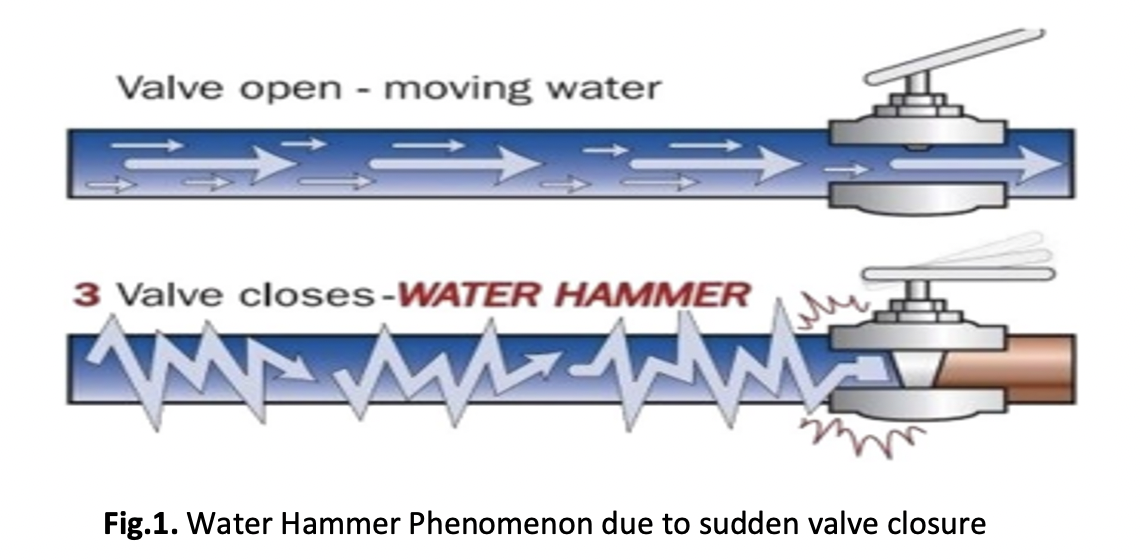
Water hammer is a serious problem in fluid transport systems that results from abrupt changes in flow velocity or direction, usually triggered by fast valve closure or pump shutdown. Such pressure spikes can lead to pipe failure, damage to equipment, severe vibration and instability of operation. The purpose of this paper is to give a complete evaluation of the causes, modelling methodologies and protective strategies of water hammer in pipeline systems. A review and analysis of relevant works was conducted in terms of numerical methods, e.g. Method of Characteristics (MOC), Finite Difference Method (FDM), Mac Cormack Method and simulation tools, e.g. MATLAB, HAMMER, WANDA, FORTRAN codes. The literature examined demonstrates that in general these numerical methods accurately anticipate transient pressure behavior and are in excellent agreement with experimental findings. It was also concluded that the best mitigating solutions include surge tanks, hydro pneumatic hydro pneumatic tanks, slow valve closing strategies and bypass systems. Recent improvements in numerical simulation and surge protection technology have greatly enhanced the understanding and control of water hammer events, leading to safer and more dependable pipeline operation.

Downloads

Published

2026-08-17

Issue

Section

Articles