
Self-Adaptive Two-Stage Anchovy-Inspired Filter Algorithm for Global Optimization

Authors

  • Azrul Mahfurdz Department of Electrical Engineering, Politeknik Sultan Idris Shah, Sungai Lang, 45100 Sungai Air Tawar Selangor, Malaysia
  • Muhammad Muizz Muhammad Nawawi Department of Electrical Engineering, Politeknik Sultan Idris Shah, Sungai Lang, 45100 Sungai Air Tawar Selangor, Malaysia
  • Sunardi Sasmowiyono Faculty of Industrial Technology, Department of Electrical Engineering, Universitas Ahmad Dahlan, Yogyakarta 55166, Indonesia

Keywords:

Anchovy Filter Algorithm (AFA), self-adaptive optimization, swarm intelligence, Metaheuristic algorithms, two-stage filtering

Abstract

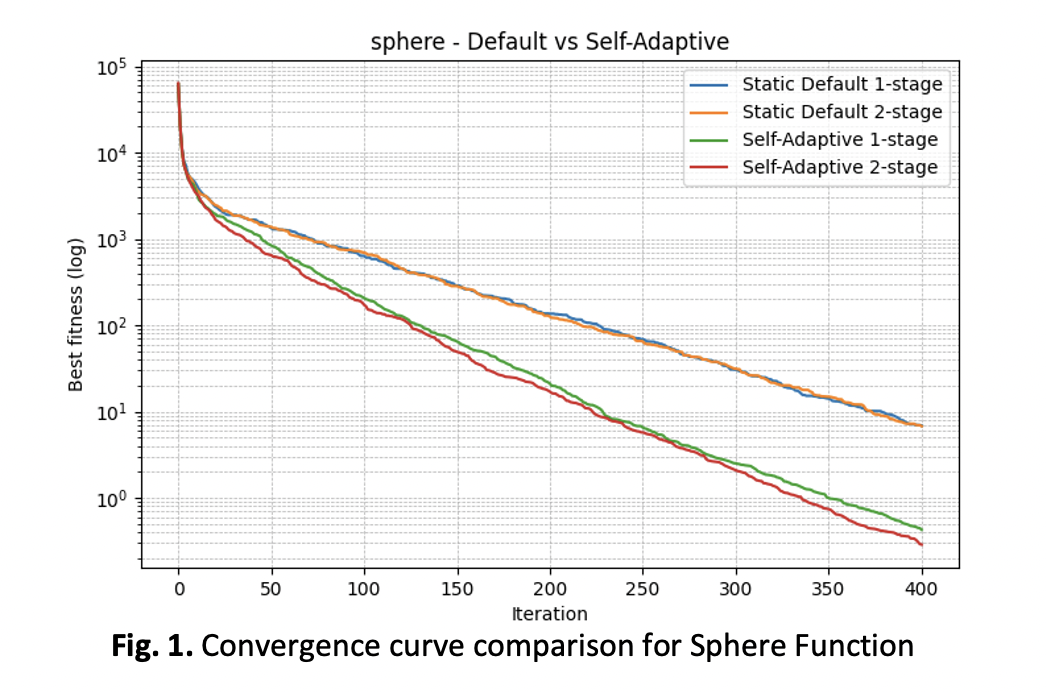
This study aims to enhance the Anchovy Filter Algorithm (AFA), a bio-inspired metaheuristic optimization algorithm, by introducing self-adaptive parameter control and a two-stage filtering strategy to improve convergence efficiency and solution quality across various benchmark functions. A self-adaptive mechanism was incorporated into AFA to dynamically adjust parameters such as step size, weighting coefficients, and noise intensity, allowing the algorithm to automatically balance exploration and exploitation. In addition, two-stage filtering was used to refine the candidate solutions. The proposed Self-Adapting AFA was evaluated against the static AFA variant using six standard benchmark functions namely Sphere, Rosenbrock, Schwefel 1.2, Rastrigin, Griewank and Ackley. Statistical performance metrics (mean, standard deviation, best, and worst fitness values) and Wilcoxon signed-rank tests were employed for comparative analysis. The experimental results demonstrated that the Self-Adaptive AFA outperformed the static AFA in most test functions, particularly for unimodal functions such as Sphere and Ackley, achieving significantly lower mean and best fitness values with faster convergence. On multimodal functions like Rosenbrock and Rastrigin, the self-adaptive variant maintained competitive performance while ensuring better stability. The Wilcoxon test results further confirm the statistical significance of the improvements. The combination of self-adaptive parameter control and two-stage filtering significantly improves the robustness, convergence speed, and accuracy of AFA solutions. The proposed Self-Adaptive AFA provides a promising optimization framework that can be extended to real-world engineering and data-driven applications.

Downloads

Published

2026-08-17

Issue

Section

Articles