Tailoring Precursor Concentration for Low-Temperature Synthesis of ZnO Nanostructures for Piezoelectric Nanogenerator Applications
Keywords:
ZnO, Concentration, Microwave, Nanostructures, NanogeneratorAbstract
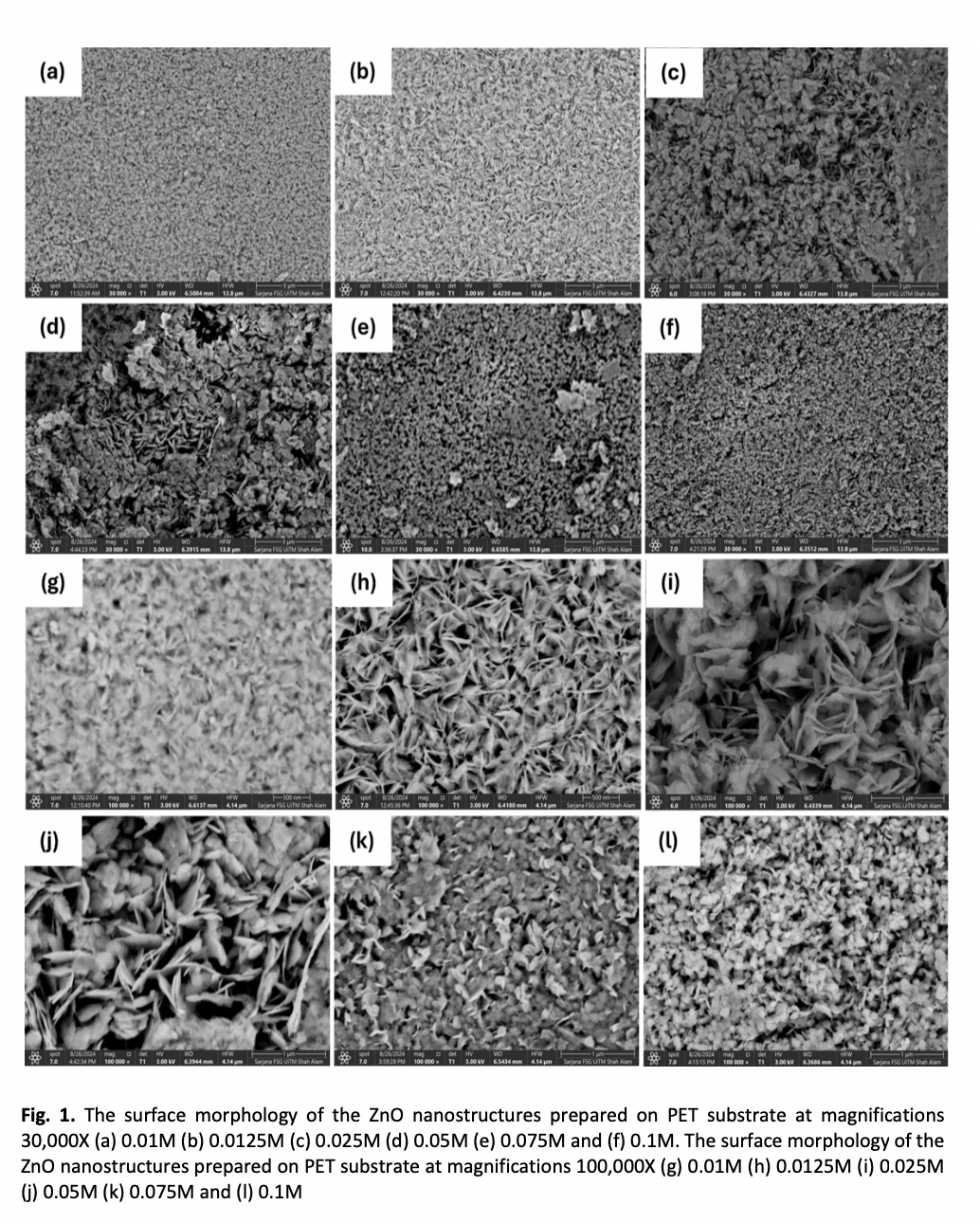
As the global demand for sustainable energy solutions intensifies, piezoelectric nanogenerators (PENG) have emerged as promising candidates for powering wearable and portable devices, aligning with the United Nations' 2030 Agenda for Sustainable Development Goals, particularly Goal 7 (Affordable and Clean Energy). Zinc oxide (ZnO)nanostructures, known for their exceptional piezoelectric and semiconducting properties, are also biocompatible and environmentally friendly, making them pivotal in advancing PENG technology. Although extensively studied, ZnOnanostructures still face challenges in achieving high crystallinity and controlled morphology at low temperatures, particularly for flexible substrates. Conventional methods like chemical vapor deposition (CVD) and hydrothermal synthesis require high temperatures and long durations, limiting their compatibility with temperature-sensitive materials such as polyethylene terephthalate (PET). In this study, ZnO nanostructures were synthesised using a microwave-assisted sonochemicaltechnique, focusing on the effect of varying precursor concentrations (0.01M, 0.0125M, 0.025M, 0.05M, 0.075M, and 0.1M) on structural and electrical characteristics. X-ray diffraction (XRD) and field emission scanning electron microscopy (FESEM) analyses were conducted to explain the crystal structure and surface morphology of thesynthesised ZnO, while oscilloscope measurements were used to evaluate voltage output for piezoelectric performance. XRD analysis confirmed the structures of ZnOacross all precursor concentrations, with variations in peak intensity and crystallite size indicating the influence of concentration on crystallinity and preferred orientation. FESEM images revealed distinct morphological changes with increasing precursor concentration. Oscilloscope results highlighted the correlation between optimised ZnOnanostructure morphology and enhanced voltage output, confirming the significance of precursor concentration in achieving efficient energy harvesting. The microwave-assisted sonochemical technique, characterised by its rapid reaction time and low-temperature synthesis (100°C), proved to be an effective method for growing ZnO nanostructures for PENG. This method’s ability to produce highly crystalline ZnOat low temperature is particularly advantageous for flexible substrates in wearable electronics and energy harvesting applications. The findings underscore the critical role of precursor concentration in tailoring ZnO structural and electrical properties,offering valuable insights into optimising ZnO nanostructures for PENG applications. This work contributes to the development of sustainable and efficient energy harvesting technologies, demonstrating the potential of ZnOnanostructures in next-generation wearable and portable devices.