The Influence of Deposition Time on Zinc oxide-based Nanostructures by Microwave-assisted Sonochemical Technique
Keywords:
Dip coating, Microwave, PET, Time, Zinc oxide NanostructuresAbstract
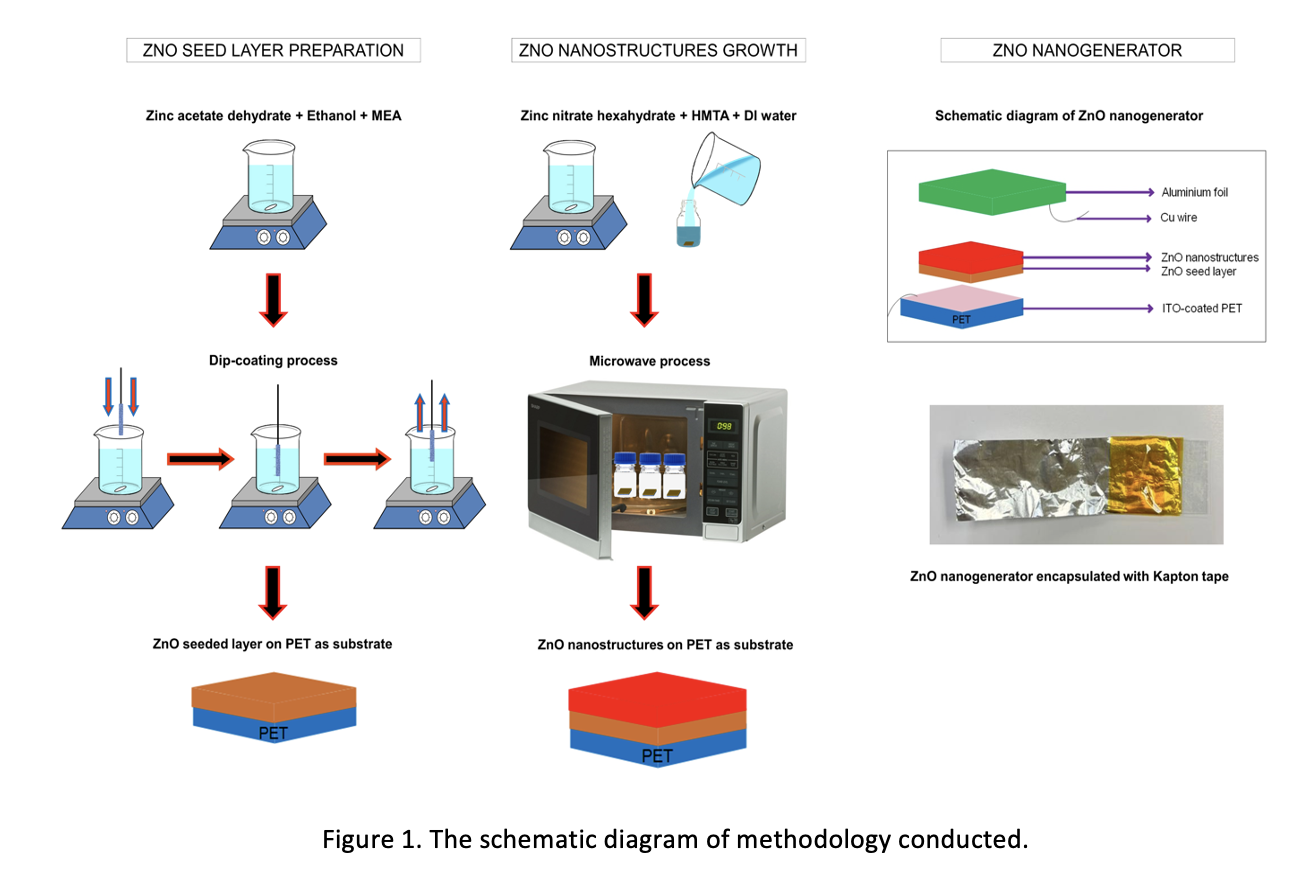
Zinc oxide (ZnO) nanostructures have attracted significant attention due to their biocompatibility and versatile applications in electronics, optoelectronics, photocatalysis and sensing. The Sustainable Development Goals emphasise the need for advanced, environmentally friendly nanomaterials, where microwave-assisted sonochemical synthesis offers a rapid and uniform approach to producing high-quality ZnO nanostructures. However, the effect of deposition time on the properties of ZnO nanostructures synthesised via microwave-assisted sonochemical methods remains inadequately understood. Existing studies have not comprehensively explored how this critical parameter influences crystallinity, morphology and optical behavior, especially when it comes to real life applications. This study addresses this gap by systematically investigating the impact of deposition time to optimise ZnO nanostructures quality for sustainable nanotechnology applications. This paper presents an investigation on the influence of deposition time on zinc oxide-based nanostructures by using microwave-assisted sonochemical technique. Zinc oxide nanostructures (Zn-Ns) were synthesised by preparing the seed layer using ultrasonic-assisted dip-coating technique on both sides of polyethylene terephthalate (PET) as substrate. The Zn-Ns growth was precisely controlled by adjusting the deposition times varying from 30, 60, 90, 120 and 150 minutes. The structural, morphological and optical properties of each sample were characterized by using X-ray Diffraction (XRD),Field Emission Scanning Electron Microscopy (FESEM) and Ultraviolet-Visible (UV-Vis) Spectroscopy. Results revealed that there is a dominant peak on XRD analysis that is believed to be the (200) cubic phase zinc oxide and different surface morphologies were also observed for FESEM images as the deposition time varies. Meanwhile, the UV-Vis spectroscopy portrayed a decrease in trend when the deposition time increased from 30 minutes to 150 minutes due to the transmittance of thin films decreasing as film thickness increases. A nanogenerator has been fabricated and an output voltage of near 8V has been obtained, proving a successful application of this study. Thus, this work suggested a new approach on the synthesisation of Zn-Ns by using microwave-assisted sonochemical technique which resulted in many potentials for future applications such as nanogenerators, dye-sensitized solar cell (DSSC) and sensors