
Quality Improvement of Hybrid Catfish Flesh: Physicochemical and Sensory Responses to Functional Additive-Enriched Plant-Based Diets

Authors

  • Norlelawati Arifin Food Technology Laboratory, Faculty of Science and Technology, Universiti Sains Islam Malaysia, 71800 Nilai, Negeri Sembilan Darul Khusus, Malaysia
  • Anis Solehah Mohd Sabani Food Technology Laboratory, Faculty of Science and Technology, Universiti Sains Islam Malaysia, 71800 Nilai, Negeri Sembilan Darul Khusus, Malaysia
  • Nurzazarina Ramly Food Technology Laboratory, Faculty of Science and Technology, Universiti Sains Islam Malaysia, 71800 Nilai, Negeri Sembilan Darul Khusus, Malaysia
  • Noor Khalidah Abdul Hamid School of Biological Sciences, Universiti Sains Malaysia, 11800, Minden, Pulau Pinang, Malaysia
  • Agbaje Rafiu Department of Food Science and Technology, Institute of Applied Sciences, Kwara State Polytechnic, P.M.B.1375, Ilorin, Nigeria
  • Panchaporn Tadpitchayangkun Promchote Indigenous Food Research and Industrial Development Center (IFRIDC), Department of Food Technology, Faculty of Agriculture, Ubon Ratchathani University, Ubon Ratchathani, 34190, Thailand
  • Norizah Mhd Sarbon Faculty of Food Science and Agrotechnology, Universiti Malaysia Terengganu, 21030 Kuala Nerus, Terengganu, Malaysia
  • Mohamad Razlan Abd Rahman Faculty of Medicine, Kings University College, Jalan Sultan Ismail, 50250 Kuala Lumpur, Malaysia

Keywords:

Catfish, plant protein diet, physicochemical properties, sensory evaluation, papain

Abstract

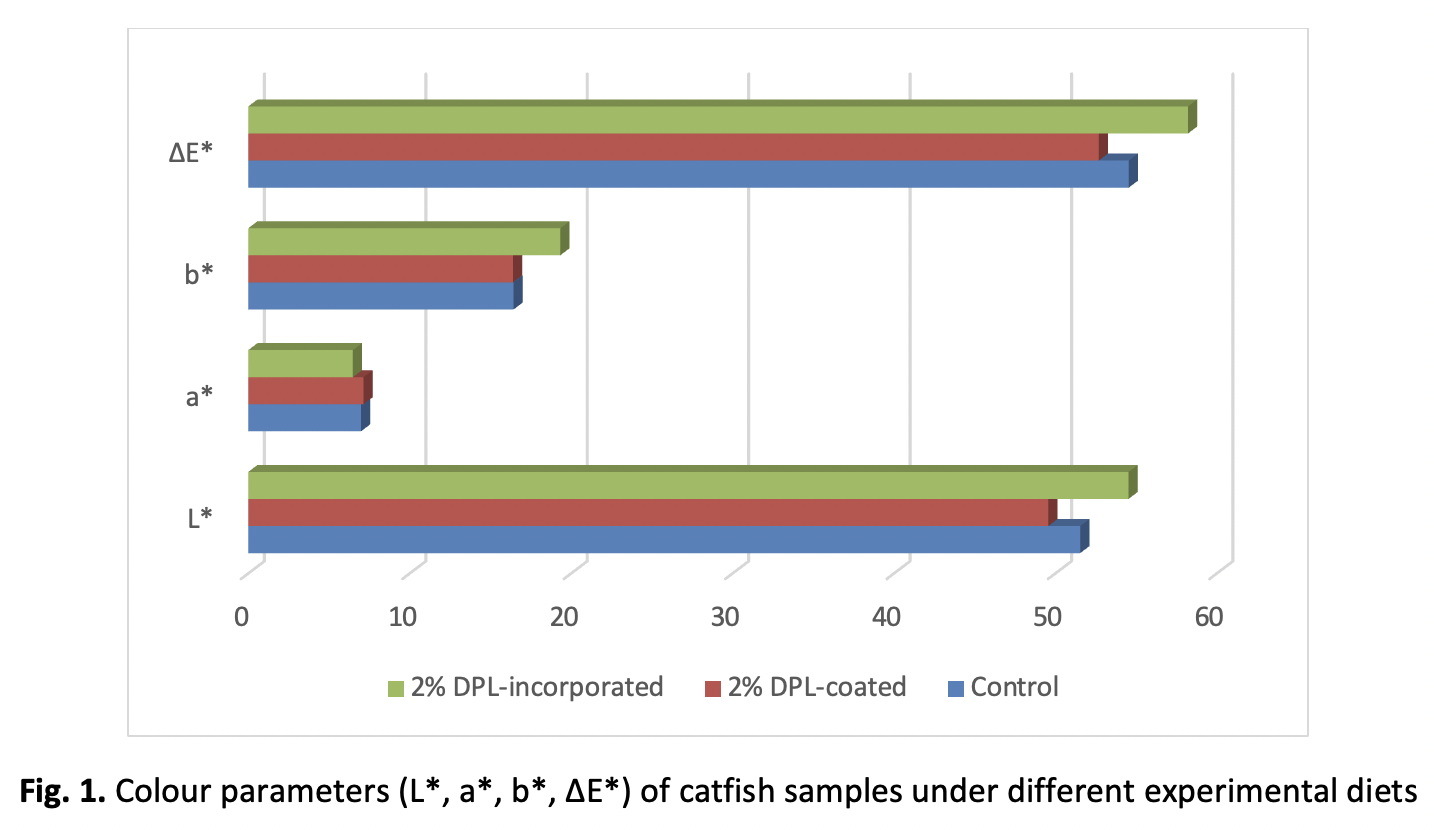
This research investigated the effects of high-protein plant-based diets supplemented with functional additives on the physicochemical and sensory qualities of hybrid Asian-African catfish (Clarias macrocephalus × Clarias gariepinus). Dried Papaya Leaves (DPL) with 2% incorporation were added to a commercial diet, and two methods of incorporation were applied: coating on the outer part (2% DPL-coated) and incorporation well into the feed (2% DPL-incorporated). A commercial diet without DPL served as the control. Catfish were reared under controlled conditions and fed experimental diets (4 weeks). The similar values obtained for moisture, protein, and ash contents indicated that the addition of DPL in the commercial diet, regardless of the method of incorporation, did not affect these properties. The lowest values of chewiness, cohesiveness, hardness, and springiness were reported for fish flesh with 2% DPL-incorporated treatments compared to 2% DPL-coated and control treatments, with no significant difference. This sample also revealed significant differences in L*, b*, and ΔE* values compared to the other two samples, resulting in a noticeable flesh colour change magnitude. A similar pattern was observed in both the Hedonic Scale and Qualitative Descriptive Analysis (QDA), suggesting that the sensory attributes evaluated may not have influenced the panellists’ scores. In conclusion, the inclusion of 2% DPL as a functional additive in high-protein plant-based diets does not compromise the physicochemical quality or sensory acceptability of hybrid catfish. These findings suggest that DPL has strong potential as a sustainable and natural feed additive for aquaculture applications. Thus, a longer feeding trial (12 weeks) is recommended for future work to better determine the long-term effects of DPL supplementation on the physicochemical and sensory quality of fish flesh.

Author Biographies

Norlelawati Arifin, Food Technology Laboratory, Faculty of Science and Technology, Universiti Sains Islam Malaysia, 71800 Nilai, Negeri Sembilan Darul Khusus, Malaysia

norlela@usim.edu.my

Anis Solehah Mohd Sabani, Food Technology Laboratory, Faculty of Science and Technology, Universiti Sains Islam Malaysia, 71800 Nilai, Negeri Sembilan Darul Khusus, Malaysia

anissabani21@gmail.com

Nurzazarina Ramly, Food Technology Laboratory, Faculty of Science and Technology, Universiti Sains Islam Malaysia, 71800 Nilai, Negeri Sembilan Darul Khusus, Malaysia

zazaramly@usim.edu.my

Noor Khalidah Abdul Hamid, School of Biological Sciences, Universiti Sains Malaysia, 11800, Minden, Pulau Pinang, Malaysia

khalidah.hamid@usm.my

Agbaje Rafiu, Department of Food Science and Technology, Institute of Applied Sciences, Kwara State Polytechnic, P.M.B.1375, Ilorin, Nigeria

agbajerafiutemitope@gmail.com

Panchaporn Tadpitchayangkun Promchote, Indigenous Food Research and Industrial Development Center (IFRIDC), Department of Food Technology, Faculty of Agriculture, Ubon Ratchathani University, Ubon Ratchathani, 34190, Thailand

pan.p@ubu.ac.th

Norizah Mhd Sarbon, Faculty of Food Science and Agrotechnology, Universiti Malaysia Terengganu, 21030 Kuala Nerus, Terengganu, Malaysia

norizah@umt.edu.my

Mohamad Razlan Abd Rahman, Faculty of Medicine, Kings University College, Jalan Sultan Ismail, 50250 Kuala Lumpur, Malaysia

drrazlan@kingsuniversitycollege.edu.my

Downloads

Published

2026-09-28

Issue

Section

Articles