
Fe₃O₄/BiOI Heterojunction Photocatalyst for Enhanced Visible Light Degradation and Detoxification of Rhodamine B Dye

Authors

  • Nur Lina Syahirah Mustapa EMZI-UiTM Nanoparticles Colloids and Interface Industrial Research Laboratory (NANO-CORE), Faculty Chemical Engineering, Universiti Teknologi MARA, Cawangan Pulau Pinang, 13500, Permatang Pauh, Pulau Pinang, Malaysia
  • Mohamed Syazwan Osman EMZI-UiTM Nanoparticles Colloids and Interface Industrial Research Laboratory (NANO-CORE), Faculty Chemical Engineering, Universiti Teknologi MARA, Cawangan Pulau Pinang, 13500, Permatang Pauh, Pulau Pinang, Malaysia
  • Anis Syuhada Saufi EMZI-UiTM Nanoparticles Colloids and Interface Industrial Research Laboratory (NANO-CORE), Faculty Chemical Engineering, Universiti Teknologi MARA, Cawangan Pulau Pinang, 13500, Permatang Pauh, Pulau Pinang, Malaysia
  • Noor Fitrah Abu Bakar Faculty Chemical Engineering, Universiti Teknologi MARA, 40450, Shah Alam, Selangor, Malaysia
  • Uraiwan Sirimahachai Center of Excellence for Innovation in Chemistry, Division of Physical Science, Faculty of Science, Prince of Songkla University, Hat Yai, 90110, Songkhla, Thailand

Keywords:

Heterojunction, Magnetic, Photocatalyst, Rhodamine B, Toxicity

Abstract

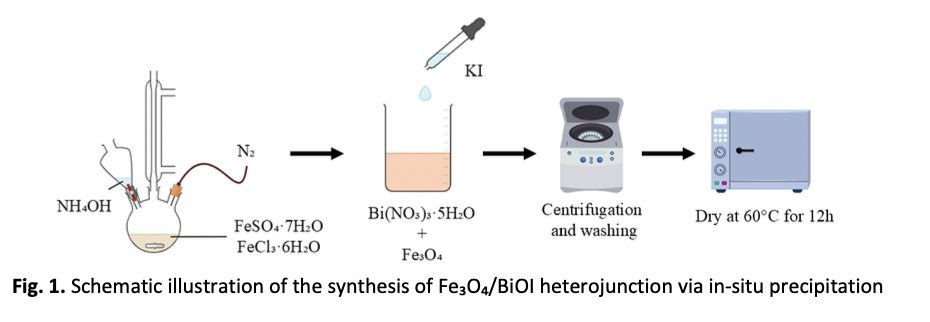
Synthetic dye such as Rhodamine B poses a serious risk to aquatic ecosystems and human health. In this work, a magnetically recoverable Fe₃O₄/BiOI heterojunction was synthesized via an in-situ precipitation route. The physicochemical properties of BiOI, Fe₃O₄, and the Fe₃O₄/BiOI composite were characterized by zeta potential and dynamic light scattering (DLS). The smaller particle size and lower polydispersity index of the composite relative to bare Fe₃O₄ indicate reduced agglomeration upon BiOI deposition. UV-Vis diffuse reflectance analysis showed that the band gap narrowed from 1.77 eV for BiOI to 1.08 eV for the Fe₃O₄/BiOI composite, indicating enhanced visible light harvesting after heterojunction formation. The photocatalytic performance was evaluated through the degradation of RhB under visible light irradiation. The Fe₃O₄/BiOI composite achieved approximately 79% RhB removal within 60 minutes of visible light exposure, considerably higher than BiOI (20%) and Fe₃O₄ (31%) alone, and the degradation followed pseudo-first-order kinetics with a rate constant of 0.0232 min⁻¹. A garden cress germination bioassay further confirmed that the treated solution was substantially less phytotoxic than the untreated dye solution, with seedling growth recovering close to the tap water control. These findings support Fe₃O₄/BiOI as a promising, magnetically separable photocatalyst for the visible-light-driven remediation of dye-contaminated water.

Author Biography

Mohamed Syazwan Osman, EMZI-UiTM Nanoparticles Colloids and Interface Industrial Research Laboratory (NANO-CORE), Faculty Chemical Engineering, Universiti Teknologi MARA, Cawangan Pulau Pinang, 13500, Permatang Pauh, Pulau Pinang, Malaysia

syazwan.osman@uitm.edu.my

Downloads

Published

2026-09-28

Issue

Section

Articles