
Assessment of Noise Exposure Levels Generated by Equipment in University Engineering Laboratories

Authors

  • Zitty Sarah Ismail School of Chemistry and Environment, Faculty of Applied Sciences, University Teknologi MARA, 40450 Shah Alam, Selangor, Malaysia
  • Muhammad Lutfil Hadi Mohd Raimy School of Chemistry and Environment, Faculty of Applied Sciences, University Teknologi MARA, 40450 Shah Alam, Selangor, Malaysia
  • Fazni Susila Abdul Ghani School of Chemistry and Environment, Faculty of Applied Sciences, University Teknologi MARA, 40450 Shah Alam, Selangor, Malaysia
  • Norazura Ibrahim School of Industrial Technology, Faculty of Applied Sciences, Universiti Teknologi MARA, 40450 Shah Alam, Selangor, Malaysia
  • Mazhani Muhammad Centre of Foundation Studies, Universiti Teknologi MARA, 43800 Dengkil, Selangor, Malaysia

Keywords:

Equipment-generated noise, Acoustic Assessment, occupational noise

Abstract

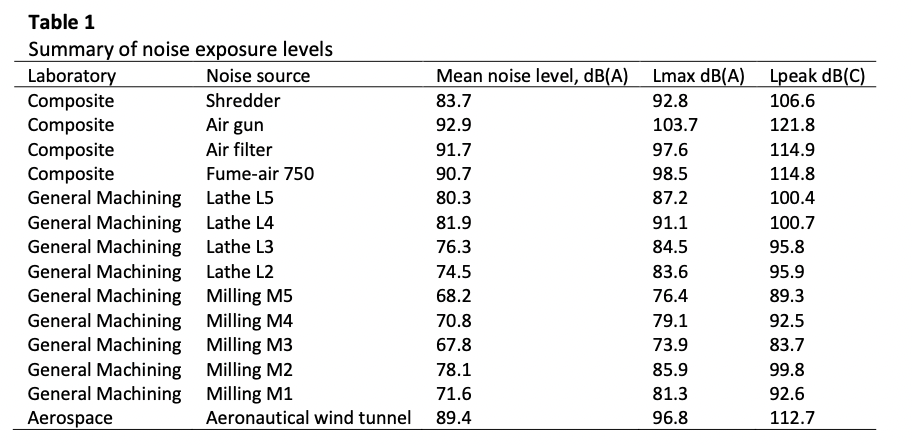
Noise generated by machinery and equipment can be an important safety consideration in university engineering laboratories. However, equipment-generated sound levels should be distinguished from individual personal noise exposure, which depends on exposure duration, distance from the source, task frequency, simultaneous equipment operation, and individual movement. This study characterized equipment-generated noise levels in selected university engineering laboratories and identified sources that may warrant further exposure assessment. A quantitative observational approach was used to measure mean noise level, maximum noise level (Lmax), and peak noise level (Lpeak). Fourteen noise sources were assessed across the Composite, General Machining, and Aerospace Laboratories. The results showed clear differences in noise levels among the equipment. The air gun recorded the highest mean noise level at 92.9 dB(A), followed by the air filter at 91.7 dB(A), Fume-Air 750 at 90.7 dB(A), and the aeronautical wind tunnel at 89.4 dB(A). Milling M3 recorded the lowest mean level at 67.8 dB(A). The air gun also produced the highest Lmax and Lpeak values, at 103.7 dB(A) and 121.8 dB(C), respectively. Four of the 14 noise sources exceeded 85 dB(A), while five exceeded 82 dB(A). These comparisons are presented as source-level screening information and do not establish individual daily noise exposure or regulatory exceedance. The findings identify several equipment sources that may warrant task-based exposure assessment, personal dosimetry, and noise-control evaluation. The study provides equipment-specific baseline information that can support a staged approach to noise risk assessment in university engineering laboratories.

Author Biographies

Zitty Sarah Ismail, School of Chemistry and Environment, Faculty of Applied Sciences, University Teknologi MARA, 40450 Shah Alam, Selangor, Malaysia

zitty@uitm.edu.my

Fazni Susila Abdul Ghani, School of Chemistry and Environment, Faculty of Applied Sciences, University Teknologi MARA, 40450 Shah Alam, Selangor, Malaysia

Norazura Ibrahim, School of Industrial Technology, Faculty of Applied Sciences, Universiti Teknologi MARA, 40450 Shah Alam, Selangor, Malaysia

noraz371@uitm.edu.my

Mazhani Muhammad, Centre of Foundation Studies, Universiti Teknologi MARA, 43800 Dengkil, Selangor, Malaysia

mazhani@uitm.edu.my

Downloads

Published

2026-09-30

Issue

Section

Articles