
Comparative Analysis of Forecasting: A Case Study of Malaysia’s Inflation

Authors

  • Chan Xiao Lin School of Computing, Faculty of Computing and Engineering, Quest International University (QIU), 31350, Ipoh, Perak
  • Khairunnisa Mokhtar School of Computing, Faculty of Computing and Engineering, Quest International University (QIU), 31350, Ipoh, Perak.

Keywords:

Inflation forecasting, Consumer Price Index, Artificial Neural Network (ANN), Random Forest (RF), ARIMAX

Abstract

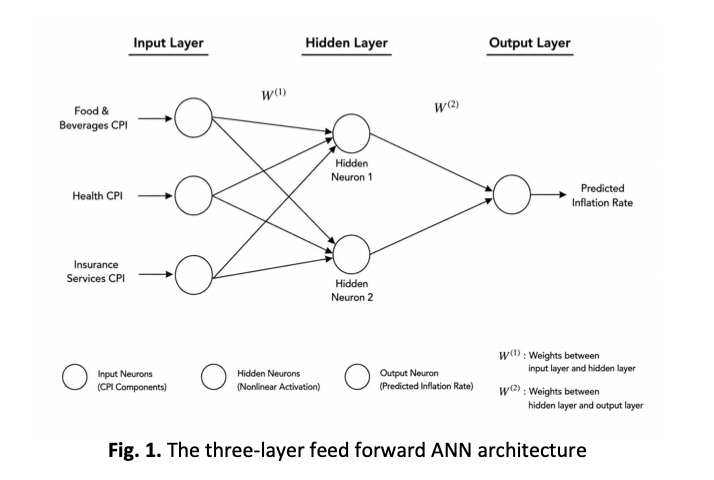
An accurate forecast of inflation is important for the stability of the economy, shaping the monetary policy and making business and investment decisions. Despite its importance, forecasting inflation remains challenging due to the complex and dynamic relationships among economic variables. There are limited studies in Malaysia that have investigated the predictive capability of Consumer Price Index (CPI) using both traditional and machine learning methods. The objective of this study is to forecast the inflation rate of Malaysia using three CPI components, namely Food, Health and Insurance Services, which were obtained from the Department of Statistics Malaysia (DOSM) from January 2016 to December 2025. A comparative forecasting framework is developed in this study using three models: Artificial Neural Network (ANN), Random Forest (RF), and ARIMAX. Data preprocessing, exploratory data analysis, and stationarity tests are performed to ensure data suitability and model robustness. Four training-testing data ratios (60:40, 70:30, 80:20, and 90:10) are examined systematically to determine the optimal training-testing data ratio for each forecasting model. The best forecasting model is determined by the lowest forecasting errors in forecasting performance measured by Root Mean Square Error (RMSE), Mean Absolute Error (MAE), and Mean Absolute Percentage Error (MAPE). The findings show that ARIMAX (1,0,2) model with a 90:10 training-testing ratio has outperformed the other models by achieving the lowest error. Thus, ARIMAX (1,0,2) is selected as the best model to forecast the inflation rate of Malaysia for the next 24 months. The forecasting results indicate an overall increasing trend in Malaysia’s inflation rate throughout the forecast period. These results indicate that ARIMAX is effective in modelling the relationship between inflation and selected CPI components, providing useful information for the policymakers and economic planners in anticipating future inflation movements.

Author Biographies

Chan Xiao Lin, School of Computing, Faculty of Computing and Engineering, Quest International University (QIU), 31350, Ipoh, Perak

xiaolin.chan@qiu.edu.my

Khairunnisa Mokhtar, School of Computing, Faculty of Computing and Engineering, Quest International University (QIU), 31350, Ipoh, Perak.

khairunnisa.mokhtar@qiu.edu.my

Downloads

Published

2026-10-09

Issue

Section

Articles