
In Silico Prioritisation of Persicaria minor Phytochemicals and Predicted Cancer-Associated Molecular Targets

Authors

  • Sharifah Nur Alia Syed Mustafa Department of Pharmacology and Life Sciences, Faculty of Pharmacy, Universiti Teknologi MARA, Kampus Puncak Alam, 42300 Selangor, Malaysia
  • Noor Jannah Yob Group for Affinity, Safety and Efficacy Studies (OASES), Faculty of Pharmacy, Universiti Teknologi MARA, Kampus Puncak Alam, 42300 Selangor, Malaysia

Keywords:

Persicaria minor, cancer-associated targets, network pharmacology, phytochemicals, arget prediction

Abstract

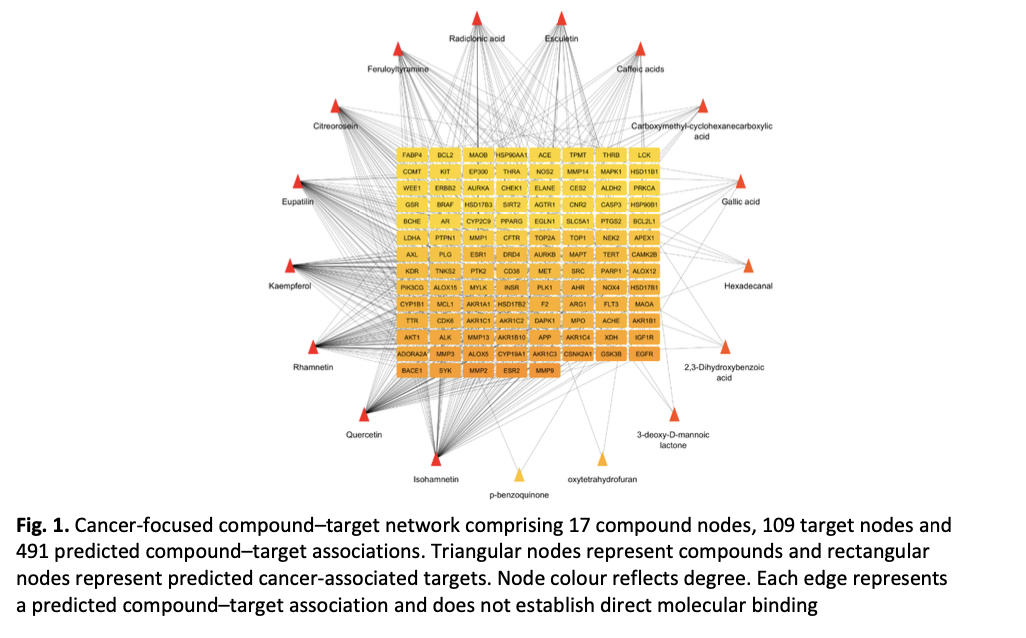
Persicaria minor (Huds.) Opiz, an aromatic herb in the Polygonaceae family, contains phenolic acids, flavonoids and other metabolites associated with diverse biological properties. This study aimed to use network pharmacology to prioritise reported P. minor constituents and predict cancer-associated molecular targets. A total of 143 compound records were compiled from published literature and public databases; after duplicate removal, 131 unique compounds were screened using SwissADME for drug-likeness and pharmacokinetic properties. Of 27 prioritised compounds, 22 generated SwissTargetPrediction outputs, yielding 207 non-duplicate predicted human targets. Intersection with GeneCards-derived cancer-associated genes identified 109 common targets. The resulting cancer-focused compound–target network comprised 17 compounds, 109 target nodes and 491 predicted associations. Isorhamnetin, quercetin, kaempferol, rhamnetin and eupatilin showed the highest compound connectivity. Protein–protein interaction analysis of the 109 common targets generated a network of 109 proteins and 1,137 associations, with AKT1, CASP3, BCL2, ESR1, HSP90AA1, EGFR, PTGS2, SRC and PPARG among the most highly connected proteins. KEGG enrichment identified multiple cancer-associated pathways, with PI3K–AKT signalling among the most significantly enriched. These findings provide a structured framework for prioritising candidate phytochemicals, proteins and signalling pathways for further investigation. Chemical confirmation and experimental validation are required before mechanistic or therapeutic inferences can be drawn.

Author Biographies

Sharifah Nur Alia Syed Mustafa, Department of Pharmacology and Life Sciences, Faculty of Pharmacy, Universiti Teknologi MARA, Kampus Puncak Alam, 42300 Selangor, Malaysia

sharifahnuralia@gmail.com

Noor Jannah Yob, Group for Affinity, Safety and Efficacy Studies (OASES), Faculty of Pharmacy, Universiti Teknologi MARA, Kampus Puncak Alam, 42300 Selangor, Malaysia

noorjannah@uitm.edu.my

Downloads

Published

2026-10-09

Issue

Section

Articles