Numerical Simulation and Experimental Validation of Heat Transfer Through a CFRP Heating Flatbed with a Sand Thermal Buffer
Keywords:
CFRP heating flatbed, conductive heat transfer, finite element simulation, infrared thermography, sand thermal buffer, thermal validationAbstract
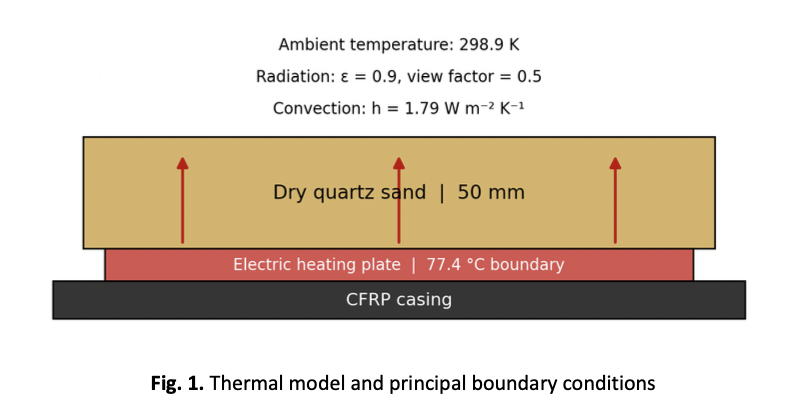
Stable conductive heating is required to reproduce desert basking conditions for captive Uromastyx aegyptia, but conventional platforms may be heavy and thermally non-uniform. This study aimed to determine a suitable sand-buffer thickness for a lightweight carbon-fibre-reinforced polymer (CFRP) heating flatbed and experimentally validate the predicted surface temperature. A steady-state SOLIDWORKS Simulation model represented CFRP as orthotropic and dry sand as isotropic silicon dioxide. The measured heater condition was 77.4 °C; ambient temperature, convection coefficient, emissivity, and view factor were 298.9 K, 1.79 W/(m²·K), 0.9, and 0.5, respectively. Iterative modelling selected a 50 mm sand layer and predicted a surface temperature of 54.90 °C. The prototype was evaluated by infrared thermography at six intervals over 240 min in three trials. At 240 min, the mean centre temperature was 55.53 °C. The absolute difference from the prediction was 0.63 °C and the relative deviation was 1.15%, below the predefined 5% criterion. The final spatial maximum of 58.57 °C shows that centre-temperature agreement must be considered together with surface uniformity. The CFRP-sand configuration therefore produced a stable conductive surface, and the model provides a practical basis for preliminary thickness selection under the tested conditions.