Organisational Factors and Self-Reported Triage Accuracy among Emergency Healthcare Professionals in A Malaysian Government Hospital
Keywords:
Emergency department, healthcare professionals, infrastructure, overcrowding, self-reported triage accuracy, staffing, triageAbstract
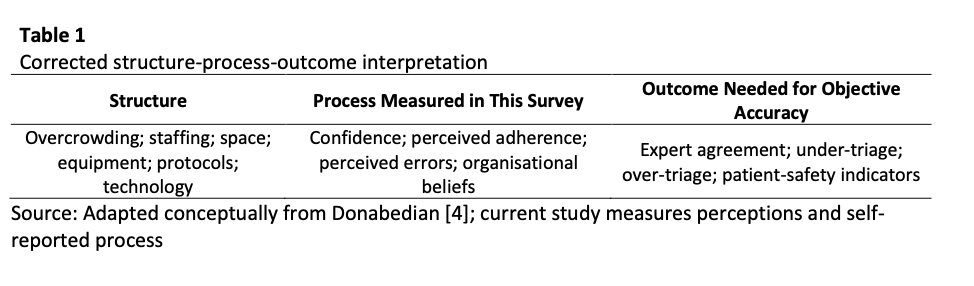
Triage decisions are made under pressure, yet staff perceptions of the working environment do not necessarily reflect how accurately individual patients are prioritised. This cross-sectional survey examined how overcrowding, workload, staffing, and hospital facilities related to healthcare workers’ self-reported triage practices at a Malaysian government hospital. A total of 66 nurses and assistant medical officers were purposively selected from a reported population of 80. The questionnaire responses were summarised using descriptive statistics, and Pearson correlation analysis examined relationships between variables. On a five-point scale from 1 (strongly disagree) to 5 (strongly agree), average item scores ranged from 1.64 to 2.42. The reported correlations with self-reported practice were r = .676 for overcrowding/workload, r = .728 for staffing and r = .586 for facilities/infrastructure (all p < .001). The findings highlight significant relationships between perceived organisational conditions and self-reported triage practices but do not establish causal effects or objectively verified triage accuracy. Further research should incorporate validated scoring procedures and objective measures of triage performance.